Transcript
Mansur: 00:04
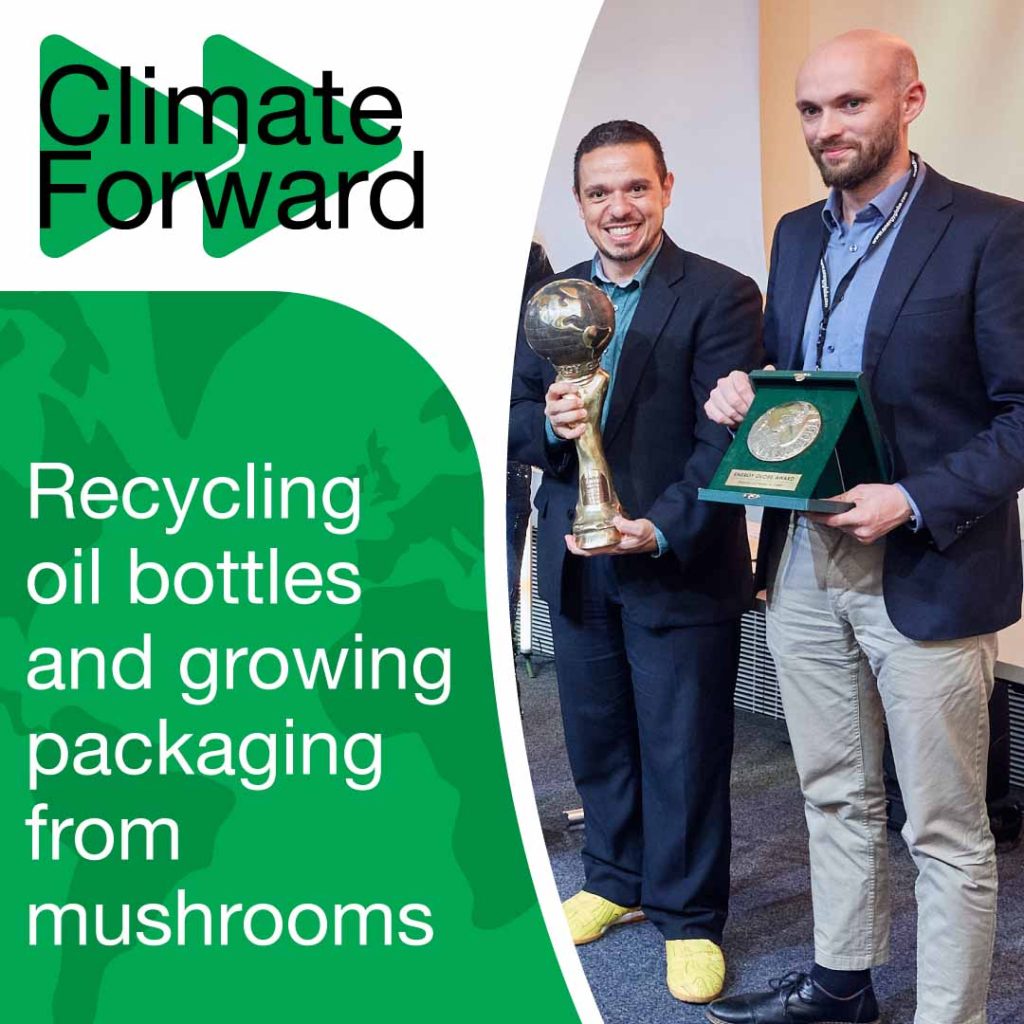
Welcome to Climate Forward. This episode is part one of a two-episode series about innovative projects from the Energy Globe Awards. In today’s episode, you will hear about EcoPanplas and Myco Limited. EcoPanplas is a Brazilian startup that has developed a unique way to recycle plastic oil bottles without the use of water. Myco Limited is a startup from the Czech Republic that grows compostable packaging from mycelium. Hi Rodrigo. Hi Mansur, how are you? I’m good, thank you very much. Thanks for taking the time to talk to me today. We are here at the Energy Globe Award, the Global Award today, and it’s something quite special because with your project, you won the award. Could you tell us a little bit about in which category you won? And also two or three words about the project.
Rodrigo Oliveira: 01:11
Thank you for this moment and to explain what we do. So we are a recycling company that invented a way of recycling the bottles, the lubrificant oil bottles, without using water. So it’s a very special technology that we have all the mechanic and the process that we can get back the oil so we do not make any residue from this process. So we can have all the plastic back from the lubrificant oil bottles so we can shred and become a new uh uh oil bottle. Um, and also we take out all the oil that we can also sell for second generation oil. So it’s 100% clean, 100% without using water, and 100% with no residue.
Mansur: 02:03
Okay, that sounds quite exciting. And maybe just to explain when you say uh lubricating oil, this is basically the oil that I pour into my car, for example, right?
Rodrigo Oliveira: 02:10
Perfect motor uh oil. So um the point is that all those lubricant oils uh we’re talking about only in Brazil, one billion of bottles that are put in the market each year, and only one bottle can contaminate 2,000 liters of water. So it’s very aggressive to the environment. And that’s why we are in the water category here at the Energy Globe.
Mansur: 02:34
Okay, that sounds very good. So uh, first of all, I think this is a really quite innovative solution. Um, I know not too much, but just a little bit about recycling, and I know that uh zero waste recycling is quite a big challenge, especially when you have such persistent contaminants like like oil. Uh I know you cannot go too much into details because uh it’s probably uh proprietary and protected uh technology, but um just to recap, you are able to completely recycle the bottle, no residues, no nothing gets thrown away, and also the oil gets recovered.
Rodrigo Oliveira: 03:10
Yes, let’s go on what I can tell you. So we can detach the residue of oil that is inside the bottles, the lubricant bottles, uh, and detach from the plastic. That’s the technology, what the technology does. So once it’s detached, it’s good oil. It’s uh regular oil that we can bring back. We already, since we started our operation, we recycled more than 500 tons of plastic bottles and recovered more than 17,000 liters of oil. Uh so when you detach, you can have the two products, let’s say the plastic that can be shredded and become a new uh uh material for new bottles, uh, and the oil that can be sold as well.
Mansur: 03:57
Are you restrained to any particular types of plastic? Uh or or or or let me ask in a different way. Are oil bottles one uh single uh type of plastic that’s used for them, caps and everything?
Rodrigo Oliveira: 04:09
Okay, so uh the main plastic that we uh recycle that is made of the the that makes the uh lubrificant uh oil bottles are HDPE, so the uh hard uh uh polyistulin. Uh we also can use for polypropylen, so the PP. Uh and uh we already addressed the technology for PET bottles. So we can uh do with ink uh buckets, we can do for um um uh personal care bottles like shampoo, conditioning, and also uh kitchen oil that comes on PET. So we already tested, but it’s not on the running. We are running with 100% the lubricant oil bottles, but we can uh drive our technology to other uh difficult and contaminated uh material that usually uh in Brazil we have 60% going to landfill and 40% going to uh damp sites. So when it goes to damp sites, it’s contaminated all over, and those are a product that really has contaminated chemistry and material that can uh be very harmful for human uh being. Uh and the point is that Brazil still recycles only 2.1% of everything that is collected. So we are very far away from European uh uh rates and some other places in the world. Uh that’s why we think that our technology is so unique uh to a Brazilian company, to a Brazilian, to a place that recycles nothing, but it can be used and licensed all over the world because recycling lubricant oil is very, very, very tough everywhere.
Mansur: 05:53
Yeah, and I can imagine, you know, everywhere there’s cars being driven, so there is uh incredible amounts of uh lubricant bottles used every year.
Rodrigo Oliveira: 05:60
Yes, and even in electric cars, you have the will oil and other kinds of oil that are being used. So it’s gonna be here. The lubricant oils are gonna be here for a long time.
Mansur: 06:10
One final question I would like to have, um, or maybe it’s not the final one, but um so here today you’re here to receive the um Energy Globe Award, the Global Award, but I know that uh there has been a path that’s leading up to that. Yes, can you quickly talk about that?
Rodrigo Oliveira: 06:27
Sure, sure. We are one of the finalists on the waters, or there are three finalists, so we would be very glad to win. But we are all already, already very honored to be here. That’s already a prize, I would say. Uh, and we have a long uh uh period on that because last year we participated on the national uh uh and we won the national uh global, the energy global world uh from Brazil, uh, but didn’t make the the global here to be here. Um so this year we we won the national and we were voted to be here at the global. So we’re very glad to be here. It’s very honored for us uh to show. I think it’s that it’s a moment, it’s a very uh special moment that we can show our true colors, let’s say like that. So show our technology. So uh how can we uh make real change for the world?
Mansur: 07:21
Well, Rodrigo, then thank you very much. I think this is very, very exciting. I wish you the best of luck, not only for today, but also beyond that, because I think this is exactly the kind of technology and innovation that we need to move forward to become more sustainable and to reduce our environmental impact.
Rodrigo Oliveira: 07:38
Thank you very much. Thank you very much, Monsur. It was an honor to be here with you.
Mansur: 07:42
This was Rodrigo from Ecopan Plus. The second interview today is with David from Maiko from the Czech Republic, a startup that’s producing packaging material from Mycedium. Hi David, hello. Thank you very much for joining me today. We’re here at the Energy Globe Awards, the Global Awards. Um, and I know your project is nominated. Maybe you can first introduce what it is that you do. What is your project? What is your innovation?
David Šohaj Minařík: 08:15
Okay, we have been hello again. My name is David Šohaj Minařík, uh, and um we came here with uh with a project called Myco or Miko, how we call it, and uh it’s actually we we produce an uh uh a mycelium-based packaging material, which is not really like we are not unique in producing this kind of material. Our uniqueness is in the effectivity of producing such a material. We are really working on making this material industrialized and make the mass production of material to have an impact on market with a single-use plastic uh packaging material.
Mansur: 08:55
For for people that are not familiar with mycelium and these things, basically what is your product used for? I mean, what what is it that you make?
David Šohaj Minařík: 09:02
Yeah, we do like uh um let’s say this safe how to call it like safe packaging material for transportation. We we packaging we we do packaging for small electronics, for bottles made from glass, for anything which can destroy, which can be destroyed by by uh by traveling or by transportation. And um our product is based on mycelium. Mycelium is a small root of fungi, uh, well known as mushrooms. And uh we grow this material. That’s the thing that it’s uh the the energy efficiency of growing, it’s much better than like normal technical industrialized producing material as plastic. And uh we grow this material from the waste we get to our company, and uh from the beginning to the end, it’s just in our company. That’s other things of the mycelium material, the benefit of it that you are not transporting, let’s say, middle product or or half product, not not finished product. There is no transportation, we do all in our company, and uh that means that there is less transportation of the material by itself, and uh yeah, and so we do like a normal packaging, you know, from any transportation package or how to call it, yeah, yeah, something like that.
Mansur: 10:37
So, like in the back in the past, when I would receive packages and say I would order glass, they were in this white uh styrofoam plastic protective thing, which is I think one of the most terrible things you can have for the environment because it gets everywhere.
David Šohaj Minařík: 10:50
It is, it is. It’s uh I mean we are not in our company or like me and our team, we are not really we are quite fan of uh of the plastic. It’s a great, great like invention. It moves us so so forward as a as a as a whole civilization. But uh yeah, but we are a bit greedy with this plastic. We don’t know how to stop to using this plastic. So, this single-use styrofoam you get from your post or your your order, it’s it that is horrible. It’s definitely horrible. Our material it’s uh it’s it’s not even compostable. There is no question about that. It’s it’s just it’s just uh let’s say some kind of organic waste and mushroom or fungi, or this mycellum as we call it. And it the thing is that if even if you put in a in a in a normal waste, in if you put it in a in a in a in uh in a compost, or even if you landfill this kind of material, there is no issue about that. There’s no toxic compounds in the material. And if you put it, for instance, in the landfill, you just some you just do something which called bioremediation of the of the area. You you make it better simply. You you you put great nutritions for the great organisms which can help the let’s say the landfill be cleaner. And that’s very yeah, that’s what I really like on this material, of this material part.
Mansur: 12:24
So I literally just can throw it on my compost in my garden and just it will decompose within a short amount of time or within a certain amount of time, or yeah, yeah, yeah, yeah, yeah. So there’s no chemicals, no processing done in the mycelium.
David Šohaj Minařík: 12:36
No, there’s just that’s the thing, it it wouldn’t grow if we put any any toxic uh uh whatever compound in it. It’s it’s just it’s just organic waste.
Mansur: 12:46
So but why why mycelium? I mean, why have you chosen to go this route and not cardboard or not recycled, I don’t know, cotton? Is there a particular I mean what makes mycelium so special for that?
David Šohaj Minařík: 12:60
It’s evolution actually. The thing is that uh we have we we’re fighting because we do packaging, oh god, you know, packaging plastics, so effective. It’s uh their production, it’s optimized the optimalization of the production. It’s one of the best of the best, you know. Better is just automotive and this plastic production of packaging material, it’s really great. So if you want to fight such a thing, or if you want to buy a piece of market of this thing, you have to use something which is already optimalized until a certain level. So fungi, it’s actually, you know, there is millions and millions of years of evolution. They do it really great, and they are really kind of, you know, they are they are learn how to survive. For me, fungi it’s mostly about imagination. It’s they there are so many ways how to survive for them. They’ve really they’re really working hard on surviving. So the evolution, it’s actually used really well in our production, and that’s what we kind of let’s say we tricked a bit this plastic optimalization or or or the effectiveness of the production of the of the plastic material because we can use this evolution and on our side, on our startup and other small teams around the globe is to make it uh effective from our point of view. So which means which means that the production of the packaging may based on mycelium, we can use evolution in mycelium and we have to optimalize the production of the packaging. That’s what we are doing now.
Mansur: 14:51
That brings me to my next question. How does it work? Right?
David Šohaj Minařík: 14:55
I mean great, thank you for asking.
Mansur: 14:59
Do you have large halls growing mushrooms? Like I mean, I imagine huge factory halls full of mushrooms.
David Šohaj Minařík: 15:04
It’s working, it’s a it’s a lab work. Basically, like a huge part of it, it’s it’s uh lab work, and it is about not a huge hole. It can it seems for many people that it’s necessary for it, but uh our kind of design it’s not that complicated, and there is no huge hole needed. So it’s about it’s about the storage room big enough to grow enough material. And uh from the beginning we we bring the waste, we sterilize it, we found our own way how to sterilize it, how to do how to do this waste clean. Then we grow my mycelium or fungi on the on the substrate.
Mansur: 15:52
So sorry, when you say waste, that is the that’s the substrate on which the fungus grows.
David Šohaj Minařík: 15:57
Yes, exactly. That’s uh that’s a sawdust from the from like as a waste. Oh that that’s a that’s a this paper waste or uh cardboard as you mentioned. And there is like actually, for instance, there is a really huge problem with a cardboard nowadays in Europe because no one wants it. No one wants it. It’s it’s uh yeah, it’s uh unneeded material, and we can use it if there is no plastic uh tape. But that’s uh that’s the other thing we are working on it. But um, yeah, so we use the waste, we we uh grow mushrooms on it, and then this uh magic voila, hoogie boogie, some kind of uh really nice uh shaping which we uh uh which we kind of keep in our our company because that’s our know-how. Uh that’s we are a bit in advance uh contra our competitors, and then we kind of grow there’s like a there’s like a final growing of the product. So and then then we kind of inactivate the fungus in the product and and voila, there there is uh there is a packaging, so there is a lot of growing, that’s the thing.
Mansur: 17:15
So it grows into the wanted shape already, or somehow, yeah, yeah. That’s that’s the there is sad that you can’t disclose it, but but this is I mean that I find very fascinating.
David Šohaj Minařík: 17:26
Yeah, yeah, you can use molds like our competitors, or you can use something else, as we do. And that’s the thing because there is again again, there is it’s more effective, and you don’t need so many plastic molds to produce this ecological material. You have to definitely no, okay, whatever. But yeah, that’s that’s our know-how to do it without plastic.
Mansur: 17:52
So that’s the differentiator that you have this know-how how to put it into the right form for packaging without using a lot of or any plastic molds.
David Šohaj Minařík: 18:00
There is yeah, there is some, but there’s not that many that it can to produce the series, yeah.
Mansur: 18:07
Maybe to to to to further the discussion here a little bit. Uh I mean for such an idea to grow bigger, it has to also work on on scale, right? I mean uh how big is the production at the moment?
David Šohaj Minařík: 18:22
Oh, it’s it’s it’s pretty small, actually. We are startup from uh from uh South Moravian, it’s a region in Czech Republic. We are production startup, we are doing ecological product. It’s horrible, to be honest, actually, because you know, because that’s that’s actually really like to do production, it’s so different than do any fintech or IT solutions, you know, because you bring really ugly product to your investors and say, like, hey guys, this is this is brilliant, this is the future. And those guys think like, oh man, that’s horrible. That’s really Jesus, it looks so oh yeah. You can you can uh keep it and go away. It’s it’s funky and okay, yeah, go away, please. So you you you kind of make it a bit better looking shape, and you go to the other guy, and it’s like hey guy, but look, that’s it’s uh we already prove it, huh? It looks better, aesthetic. Uh oh. So there’s so much, you know, it’s horrible to have production and produce ecological kind of organic solution, right? But uh for now we are working on uh on the line, which is going to be it’s about automatization of the production, it’s about uh it’s about like low energy sterilization of the substrate, which is that’s what we are working on now. And uh that’s the that’s the that’s the that it’s going to be it’s going to be like a big step forward for us to finish this line, which is like a like we are already order the machines, we just have to connect it and uh and uh next yeah, then next step is multiplying of the of the simple solutions. Yeah.
Mansur: 20:11
Well it sounds like you know, uh it sounds like a very exciting journey, but it also sounds like a strenuous journey. And I know that when you want to start a company or you do a startup, um it takes a lot of energy. So you better have an excellent motivation and very good uh personal motivation to do it. Um what is your story? Why did you do this?
David Šohaj Minařík: 20:35
Uh my story is uh one of the best motivation I can probably get. Uh actually, my uh my university it’s uh it’s a Royal Danish Kunstakademy. I I was uh quite okay painter, and I’m still hopefully is quite okay painter. Still I am. Uh but uh our second kit actually, I I I I all my life I’m nerd. I really I kind of hunting hunting information. I I am learning, I I I actually I’m maybe the unique person who really reading PhDs. I really do read those researches, and uh it’s really interested me, and I really feel that there is so much energy and so much research put in this or in those works that it’s kind of worth it to read it, and I liked it. Uh after our first kit with my wife, uh I’ve I I already worked with it with Fungi, kind of hobby grower and uh hobbyist as a as a mycologist. Well, our second kit, there was uh when she when she when she came, uh she was she was very very sick. She fight for her life for almost a year, and we kind of you know, and when you stand in those in those surgeries or hospitals, and you you you you you stand in the corner and you are kind of a useless. You are just there to to to to to have uh to to be afraid of everything, and uh and I was uh in this point, like my wife was uh taking care of her, I was taking care of our older son, I was a lone parent, and I was on the other hand, I cannot sleep. I that’s that’s something I have all my life. I cannot sleep. I sleep like five or four hours a day, and that’s that’s all I can give it to sleep. So um I cannot sleep. So when you cannot sleep, your kid is uh dying, literally. You are pretty uh it’s you know it’s it’s a unique situation you really go mad, or you’ve really found something you can do. For me, because I’m this nerdy or nerd guy, I found okay, I need to study something. I need to I need to put my brain somewhere and use it. Better use it than than just uh think about the scenarios which can happen. So each night I uh I clean our bathroom and I start working with uh with the fungi because my daughter, in that point, there was really there was no we have been sure we haven’t been sure if she will survive, but if she will survive, then there was some kind of problems she will definitely face in the future. One of those problems was uh was a glaucome, it’s it’s a problem with the eyes, and I found in my uh previous research that there is some great mushrooms who can help with this glaucome. So I found okay, I’m going to grow those mushrooms and I’m going to do it now. Because uh it’s about it’s about to find something to do, it’s always about something you you have to find something to do. You cannot stand in this corner, be scared, and don’t do anything. So, okay, I cleaned up the bathroom and uh I started growing mushrooms. Then, because I I I’m artist and I really love material world, somehow I found that I can do from the rest of the growing, I can do some some material, some shapes and some stuff. So I start uh kind of making research about that and uh and producing this material. Then I I uh I talked to co-founder of our project that hey look, it’s it’s it’s a brilliant material. It can it can be anything. And he was he’s he’s really as I mentioned, he’s a kit of automotive. He was no, no, no, it’s not effective, it’s not robust. You can you cannot produce it. And I was like, hey, I found the solution and you will go with me making startup of it and and everything. But you know, I do I’m going to find a solution, then I show it to you. So it was like one year for like make this guy kind of convinced that it it can work. I’ve really spent so much time on producing this material in our bathroom. Then my atelier, then I kind of oh man, it was a whole it was a horrible yeah. On the other hand, our daughter is fine for now. She’s a brilliant little sweetheart. She’s um she’s a really good girl. And uh finally I convinced this guy to make this project uh with me and only with him. I can definitely do this because he’s the automotive by itself.
Mansur: 25:52
Wow, that’s quite a touching story that’s uh that’s behind the startup here, I have to say. And uh yeah, I have you know when you have kids yourself, then uh you can very much relate to that, I think. So um I can imagine that that keeps you going also now a little bit once the momentum is picked up.
David Šohaj Minařík: 26:09
Uh there is other things, you know. In this con I found that the only the the the worst thing which can happen to me, it will always happen to my kids. No one can do anything to me. It’s going to be worse. And if we think about the future, that’s what we do for our kids. You know, there is that’s that’s the thing. This is globe, this is planet, you know, it’s it’s uh that’s the place they’re going to live and their k their kids and so on and so on. So if I if they cannot do anything worse to me, I have to try as hard as I can to do something for them because there is something really, really horrible they’re going to face, you know, somewhere in the future. We know it already. So do it how it is. So I found like, hey, there’s so much motivation. I don’t know, like that it’s not about motivation, it’s the only thing you can do.
Mansur: 27:10
For me, I think that’s a that’s a great uh quote or a great sentence uh to finish off on because you’re right. I mean, what what else can we do than to make sure that our kids have a good future on this earth? Exactly. So, David, thank you very much for talking to me. I think it’s an exciting story. I’m very curious uh to see where where you’re going with your startup. I wish you all the best, and once again, thanks for taking the time to talk to me.
David Šohaj Minařík: 27:35
Thank you a lot, thank you for having me.
Mansur: 27:39
This was Climate Forward with Rodrigo from Ecopantas and David from Myco. If you want to learn more about the European Climate Pact, its ambassadors, and their actions, hit subscribe so you don’t miss out on new episodes.