Show notes
Episode Summary – “Youth, Art, and Climate Action with Tjebbe Boersma”
Key Topics & Guest Insights
- Bridging art and activism: Tjebbe, one of the first European Climate Pact Ambassadors, combines his studies in biotechnology with creative projects like photography and music to raise awareness about climate change and mental health.
- Learning from Japan: During his exchange in Kyoto, he explored the intersections of science, culture, and empathy, experiences that deepened his environmental awareness and sense of global responsibility.
- Youth engagement challenges: Despite his efforts to involve young people in urban greening and mental health projects in The Hague, participation has been limited, highlighting the gap between enthusiasm and sustained involvement.
- Vision for sustainable living: His long-term dream is to build a tiny-house community focused on self-sufficiency and renaturation by reinvesting earnings from creative and scientific work into nature restoration.
- Biotech and healthy aging: As a biotechnology student, Tjebbe is fascinated by the potential to extend healthy human life and reduce age-related diseases, while ensuring such advances are accessible to all, not just the wealthy few.
What You Can Do After Listening
- Get involved locally: Look for youth or community greening initiatives in your area. Help remove tiles, plant native vegetation, or start a local “green corner” near a school or supermarket.
- Support creative climate voices: Follow or fund young artists using art, photography, or music to communicate environmental messages.
- Advocate for equitable innovation: Read up on healthy-aging biotech and join discussions about how new medical technologies can be made accessible and sustainable for everyone.
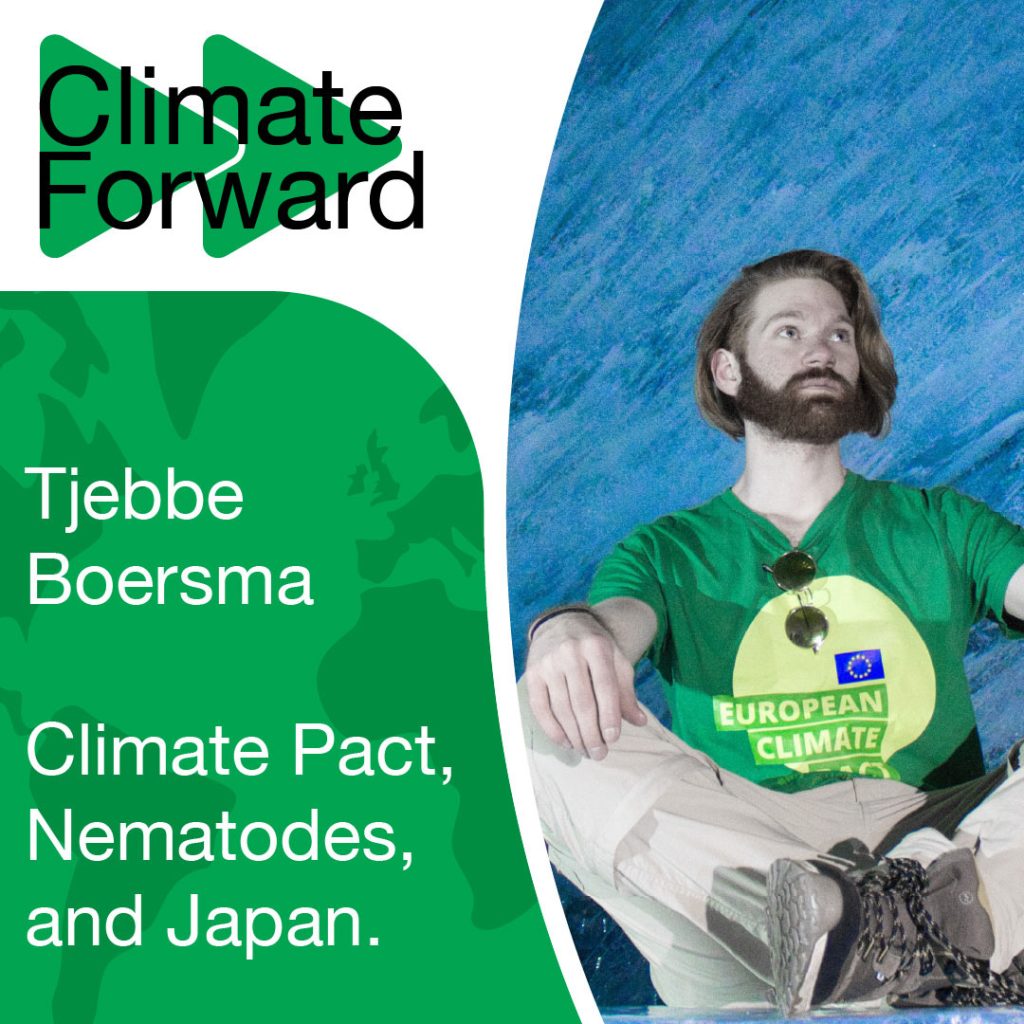
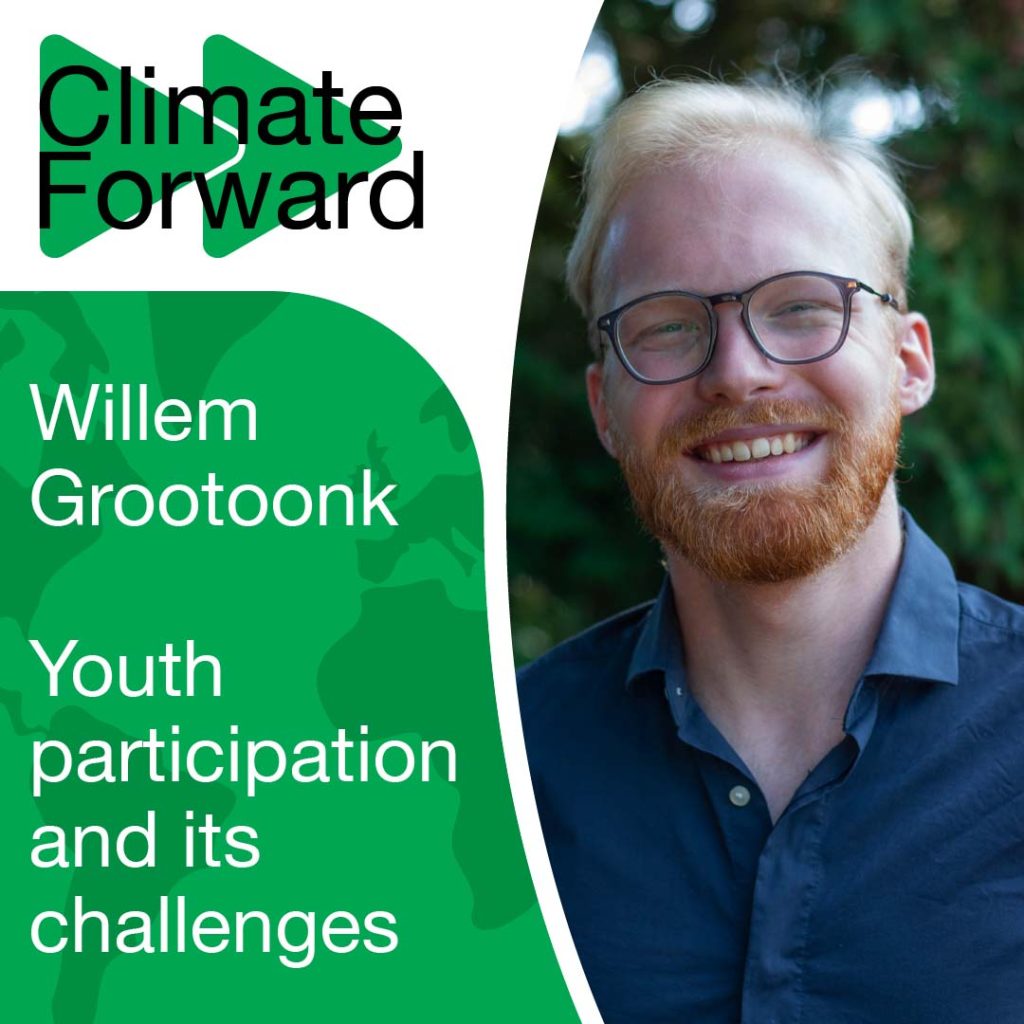
Tjebbe Boersma
Tjebbe Boersma is a life sciences graduate and climate advocate based in The Hague. With a background in biotechnology and research on aging, he combines scientific insight with creativity through his work in photography, music, and youth-led climate initiatives. As one of the first Ambassadors of the European Climate Pact, Tjebbe is committed to connecting people and ideas to accelerate sustainable change. His work reflects a deep curiosity for how science, art, and collaboration can drive innovation toward a more resilient and inclusive future.
Links
Transcript
Mansur: 00:05
Welcome to Climate Forward, the podcast where we explore the actions and stories of the European Climate Pact ambassadors. My name is Mansur Philipp Gharabaghi and I am your host. In this episode, I speak Tjebbe Bursma. Tjebbe is a European Climate Pact ambassador of the first hour. For more than four years, he has been active in the pact. He speaks about his experience of living in Japan, working with local youth on mental health projects and climate action, and his passion for photography. Great to have you, and thanks for coming to The Hague to speak to me.
Tjebbe: 00:55
Yeah, thanks for having me. I I like working together with projects that are already in The Hague, as I do know a couple things here about the city, but not this yet.
Mansur: 01:04
Now good to have you. You’re a climate pact ambassador, but you also do a lot of other things that touch upon the topic of climate change or climate protection, and we’re going to talk about one or two of those today. But first, I would like you to introduce yourself.
Tjebbe: 01:21
Okay, so I’m Tjebbe Boersma and I’m a student at Leiden University. I’m in my last little bit, so one or two months, and then I’ll be done beyond studying. I’ve always tried to do a lot of side projects with some I hope to also guide them in some way that I can uh help in the climate fight, basically. Um, one of them is photography. Now, how you combine that, that is a bit of a difficult question, but uh highlighting maybe the problems that you can see out in the world, or um somehow directing the money I can make with it to some project that can help climb it or that can help fund planting new trees. That’s something I want to do. And beyond that, I’ve also now recently started a band project with friends in the hopes that they can develop their passions and at the same time we can maybe spread a bit of a message about how you can approach certain topics. So we want to make our own music and maybe help people emotionally with the lyrics in some way, like have a bit of a message in there, or some in and also in some sense with climate, because our name is also PhonoSyn, which comes from Phonosynthesis, which comes from photosynthesis, so uh which is my photo project as well, with a space in between. So yeah, that’s how we got that going, and a lot of other things, but um basically I just try to make sure that I help out people and work together on cool projects.
Mansur: 02:57
And you’re a climate pact ambassador, one of the very first hours, I understand. I would like to know what brought you to the climate pact, and also how did you find out that there is the climate pact in Europe?
Tjebbe: 03:13
Well, I found out because my ex-girlfriend actually always heard me talk about oh, this is wrong in the world, and this should be done that way, and this should be done that way. And then she was well, okay, go prove it. Uh, here’s the climate pact, apply. And I was like, Hell yeah, I’ll apply. I know that I if I like I am quite confident about the way that I can write things or the way that I can show my passion, and well, I did, and it gladly worked out. They accepted me. And then she was like, Whoa, okay, you actually managed. Now, now what are you gonna do? So, my hope was to um at that point help out at the university. There was a green office. I mailed to them a few times, they never replied, so my plans changed as they usually do, but I did do my best to help out other projects that work on climate-related issues. Um, that’s always been a bit my passion to help out other people with what they can do and just um see how I can help either with photography or with with managing stuff. So um, but also I did I applied when I was still in Japan, I think. And when flying back to the Netherlands, which in itself is not a good thing to do flying, but I I was there for six months, so I do think it’s at least that I use my time well, and that’s something I always intend to do. When flying back, you you see all these fields, all these farms barely any nature, just squares, so so human, so so yeah, made by human hands. And it’s interesting, it looks interesting, but it’s not pretty, and not the the idea behind it is also quite um yeah, it makes me a bit sad, especially there’s such big parts of it. Like Netherlands is just basically farms. But also beyond that, like if climate change goes the way it’s going right now, then yeah, it might very well be flooded. Like my country might very well be flooded in a few years, and I might not be able to live there when I’m old.
Mansur: 05:23
So yeah, that’s that’s there’s a few points in I want to come back on. Maybe let’s start with you were in Japan. What did you do there?
Tjebbe: 05:33
I always wanted to go to Japan since I was very, very young. My brother kind of made me fascinated by all the things he was fascinated by basically. Um and when I was studying and my um I was doing well enough that I was allowed to apply for um a year abroad or well a semester abroad in that in this case. And when I did, I just uh immediately put the four Japanese universities and I was applied, I was allowed to go to my first choice, Kyoto, which is the old capital, full of cultural heritage. So really glad to have been able to go there, and there I also, as a biotechnologist, was able to work in a lab focusing on nematodes, so like microscopic worms that live in the soil. And I actually also use that in later projects in my master’s thesis. Actually, I uh introduced nematodes into Lyder University as one of the first research groups we now work with in. And there’s now new people continuing the project, which is really cool. And beyond that, also a bit of plant science and other things. But I mainly just learned a lot on my own of how to live abroad.
Mansur: 06:48
In a very, very different culture, I would assume.
Tjebbe: 06:51
So there’s a different way of going about things. There then like before going there, I always had the you hear this thing called hone and tateme. It’s like the the the truth and the face you hold uh to the world, basically. But I think Japanese people have always been very direct with me. If I am quite direct with saying, like, hey, you can’t say no, it’s okay, I’m just curious about it and I want to ask. So and and but at times we have been even invited. Like at one point, I did a pilgrimage through the southern part of Japan in Wakayama. There’s one of the two UNESCO World Heritage pilgrimages, uh, and I was allowed to stay in the garden house of two old people there with my limited Japanese, and and just I was really like, is that okay? And do you really want us there? And like, and they were like, Yeah, yeah, yeah. Because these people themselves are also curious about you, and they are just in their heart, I believe, quite kind people always. I’ve never had the idea that people had some facade or were lying about stuff. They were honestly curious and they were honestly wanted to help. It’s just that a lot of people that go there don’t speak the language. Now I’m not great either, but even with a little bit, you can really convey a lot to people in a different culture.
Mansur: 08:10
Okay, but so Japan was really focused on your studies, right? I wouldn’t say studies.
Tjebbe: 08:16
I I was there throughout the week a lot, but in the weekends I went everywhere and that I could basically. Um But isn’t that what you should also do, right? Yeah, that’s definitely what you should also do. Anyhow, before that, I was always concerned about the economic disparity that’s visible in the world. Just billionaires compared to half of the population having less than them, and also always for the climate. But I never really knew how. My idea was always found a party, a new one, but there’s already too many at the moment in in the Netherlands. And yeah, after after I came back, I was more convinced that I should just not worry about the exact way that I was gonna help, but just involve myself in groups and projects of people who are already doing things and then help them out. I think that was the best way. Because I do have one plan of helping out, but it’s really small in comparison to what’s needed.
Mansur: 09:37
Um, but next to Japan, and I hope I pronounced this correctly, the nematodes almost, but yeah, nematodes, yeah. Um that that and they they they do what? There are microscopic worms in the soil that do what?
Tjebbe: 09:52
It has been speculated that if you gather up all organisms and then put nematodes on the other side, they might weigh as much as all the other organisms on the planet because there’s just so many of them that crawl around in the soil and they they don’t have one specific function. There’s some that are parasitic, some that just eat the bacteria in the soil and are not harmful at all. It just depends a little bit. But sea elegance is the one that we use a lot for in of use a lot in research, and that’s um just found everywhere around the world basically in the soil.
Mansur: 10:28
That brings me back to your view out of the airplane window of the Netherlands as a bit of a fragile country, fragile man-made country, I want to say, because of climate change. Um that was something that triggered you to say, okay, I really want to do something, or might have been close to the last drop, I guess.
Tjebbe: 10:51
Yeah. One of the few times I really had some tears, like, oh damn, we’re not doing well at all. And what am I doing? I’m just here flying back in a plane, uh, having the luxury of having had the luxury of being able to study in a different country while there’s billions of people who’ve never left their own country or are still living basically in in mere subsistence from a simple job, and here I am polluting. I didn’t feel great, but I I do believe that I learned a lot from my time there, but I’m not sure it was necessary for me to go there.
Mansur: 11:30
You know, I believe there’s all there is value in seeing other cultures beyond just having a nice experience yourself. But if we do not, as humans, exchange with each other beyond our tiny little bubble that we live in, uh I think it would also limit our view and maybe also our empathy for each other. Definitely, yeah. I I think cultural exchange is is very has a certainly a value.
Tjebbe: 11:59
The inter the interchange between peoples is so rewarding for anyone. The main problem is that it’s it’s also something that’s not shared. So I really felt like oh, I’m this luxury kid living in a rich country that gets a chance to do this, and so many others never get that chance.
Mansur: 12:16
Maybe not the best segue, but you’re also a climate pact ambassador, and as climate pact ambassadors, we are all have all submitted a focus area or at least described a few projects that we are interested in. What are you busy with as a climate pact ambassador specifically?
Tjebbe: 12:33
Well, I I actually I wrote it down, let’s say, well, that was four years ago almost, and that you started to snowball into a lot of little projects. So beginning of the year, I also helped out make a mural that in some way talks about um it doesn’t talk about it shows a little bit of uh climate change and and and in terms of birds, it was this uh had this significance that that there’s these um uh parakeets, these green parakeets that fly through the Hague, and they were used as like they’re not natives basically of The Hague, but they’re now a big part of The Hague, so it also had a bit of an immigration idea to it that we they they contribute to The Hague and what we love about it.
Mansur: 13:26
There were a few words in in what you just said where I want to come back to. Youth and politics is a topic that uh we discussed uh a few uh episodes ago. Um we talked about youth participation as a challenge to to institute in an effective way. What is your view on these activities? Do they are those sort of you know photo moments that are done to look, I’m talking to the young people, this is so great. Or do you feel that those are genuine initiatives where we move in the right direction to at least listen to the people who will probably be most impacted, or at least the people in our society who will have to bear the change of what we’re causing now?
Tjebbe: 14:20
Um I’m gonna lean more to photo moments, I’d have to say. But from both sides. There’s things that that I’ve I’ve worked with people in The Hague. There was this um in Los Dawner, it’s like the southern part of The Hague. They have their own office basically for managing things in that part of the city. And we had a meeting there with like let’s say 20 or 30 young people like under the age of 27, most just now done with high school, and they all seemed like, oh yeah, things are not going the way I want them to, especially like it was late late Corona lockdown-ish times, and they wanted to change things, or they wanted to have their voice heard, especially about mental health, that was a big thing at that point. Um, and of that group, I think maybe two are now still busy with some projects in The Hague, but none of them with that project. So I kind of just when I give my word to something, I really try to see it through. But I ended up a year later with just doing a project entirely on my own. We um we had the idea to do like the mental health project, combine that with the mural, and then go on with some other things. Um, and also um, I kind of at Sclimandemaster, I said, Well, why not make the space greener? That’s also good for mental health, have more greens in the city, in places that a lot of people come to, maybe, maybe even the boring places, literally where you go to the supermarket. Why not just make that a place where you want to go to with joy with actually seeing some bees, some some butterflies, some nature, some some living things instead of just concrete? And I said, like, what we can do, what the city itself also wants to do is remove tiles and put plants there. And the day when we were actually gonna do that, and that we actually had some food arranged for for youth to show up, and we talked to some youth. Uh we had our low estimate was like ten people showing up. There was no one, I was the only one, I was the only one, and I just removed all the tiles from the from the ground. Uh it’s surprisingly easy, actually. And then I put in some some plans on my own. Took me one and a half hours for quite a large part, and it went really quick and was actually a lot of fun. But it’s just such a shame that it’s incredibly difficult to involve youth with these things or to to really have them show up on the day and not just get them excited for one moment and a couple months earlier.
Mansur: 17:20
Switching to something else, one of the reasons we’re sitting here today is because you’re doing a photo project, and that is that is one of the things I I still want to touch before we round off. You’re doing a photo project with the city of The Hague.
Tjebbe: 17:32
Well, it started out with one of the discussion meetings about how we were gonna do the whole removing the tiles and getting some plants in there, or like continuing with the mental health project. And then one of them said, like, hey, there’s some funding you can get, you can get some subsidies for a project of your own. It’s um getting youth involved in cultural things. And at first I was just still sitting in in my chair thinking, like, oh, there’s so such a small amount of people here, and probably nobody’s gonna show up the next time we actually do the thing. But so I was a bit I I I disregarded it at first, but then then I was a bit like, hmm, cultural. Well, I make photos. Well, I know some people that wanted to start a band, my friends. Maybe somehow we can combine this and make it both good for youth in The Hague so that they can show how to like we can show them in some way, like how do you start this, how how much fun is it? How does a certain instrument feel? Because I get it’s not just enough to know how to play an instrument or just get a course for that. You should also know why you want to play it, and especially for youth when they don’t know when to start, those things are important, so you kind of want to focus on that. And um at the same time, maybe also guide it in a little bit of a direction of the of climate, which is difficult with cultural things, but uh, I’m trying, especially with the photos. I’d like to make it of people that are doing something for the climate in The Hague or places beyond The Hague. So that’s how it started. That’s that’s basically how it started. I was like, well, let’s just give it a try. And uh yeah, again, like what I said, I am quite confident about my writing sometimes, or especially about yeah, like showing my passion in writing, and then we got them, and I was like, Yes, I knew that I could do this, which really made me happy that I was like, okay, well, apparently, um, the side of like politics and and organizations does suit me more than maybe businesses and stuff. Because sometimes I’ve I’ve also worked together with a business at some point with translation work. It does sometimes feel quite wrong to me to make so much profit over other people doing work. So uh yeah, it was fun to see myself being able to work together with public organizations, organizations that really want to do well for people, because that’s also my passion to really make a bit of a change somehow.
Mansur: 20:04
Maybe to round off, I’m curious: biotechnology, interest in politics, writing, music, photography. Where do you think uh you’re headed next?
Tjebbe: 20:18
Well, I had this dream like, oh well, maybe I could just if I work enough, if I just do my studying and then have some work on the side of it, and then if I get actual work and then have also some work on the side, if I could get a house, because it’s just impossible at the moment for youth. Please change something about that politics. Uh um, just just be able to get a place of my own, especially like a tiny house. That that’s really my goal. So in some way, direct a little bit of the money from all the projects that I do, in some way get a little bit of money with them, direct it to a tiny house community, like with friends, with people that also want to do something for the climate, uh, growing our own vegetables, all that utopian stuff basically. But really, like expand on that. Any money that I make, I just would like to invest in literally buying up land, giving it back to nature, getting more forests in the Netherlands or any other place in the world where they need it. So, yeah, that that’s something that I’d really like to get going. And all these projects are just there to maybe in some way contribute to that in a way that’s fun for me. Like, photography is fun, uh, music is fun, writing can be fun, still want to write a book sometime. And then my goal is like any money I make with it, straight towards buying up land, giving it back to nature. That’s my goal. But the whole biotech, yeah, of course, that’s just gonna be my day-to-day job, my nine to five, uh being able to sustain myself in that way. My goal is a bit to do either of one thing. If I see something that I think I can be convinced by that it can help the climate, then I would like to join that project in biotech. But I did go to Leiden, like I studied for my bachelor in Leide and in Delft. Delft is more like technical, working with business, and Leide is more medical in that sense. For my master, I chose Leide to go medical. Because I’ve always been fascinated by the following is that we could make aging just go away. Just that they’ve already managed with mice that there’s these mice that are comparatively 120 years old. Not that they’re actually that, but like if if you would calculate it back to humans. Um and they’re still healthy, they’re like in an almost 20-year-old body. There’s even mice that have been able to regrow hair so that they they got their hair back, they got their memory back, they would they’re able to do mazes again, which old mice are not really able to because they are just mentally less capable, and they got muscles back, and and I was like, whoa, okay, we can literally, if we could do this, if we could keep humans just healthy, like not immortal, I don’t care about that, that’s bad, anyways, maybe. But just to keep them healthy into their old age, you would remove so much need for medication because when somebody’s over 60, that’s when they really start to take up the costs of society, like then that’s when they’re gonna get expensive in terms of medication or help or all that. So, how cool would it be if people can sustain themselves a little bit till they’re 100, have more healthy years in which they can travel, in which they can see, in which they can do projects, and not just be fighting against their own body and how they’re like like feeling in the morning, like, oh damn, I’m I’m really feeling bad because my bones just hurt. I imagine if we could just change that. And we’re getting we’re getting so close with testing animals, why not take the next step for humans? I would really love to see that. And some people then say, oh, but that’s bad for the climate. More humans getting older, all that. And I’m like, well, if we just eat less meat, we’d already be able to hold a lot, like we’d be able to keep a lot more humans on the planet without it being a problem. Um it’s just a bit of a political choice, but yeah, I would really love to see more healthier than people. Maybe not fight the tumors that are arising in people that are like 80, but just prevent them from becoming a thing altogether. Just make it that these people stay in young, healthy bodies that don’t develop all these kinds of diseases, no more dementia, no more Alzheimer’s, no more tumors, no more uh arthritis, all that can be stopped if your cells just stay young, and we’re already able to with animals. So next step would be humans. That’s that’s something I’d really be interested in in terms of biotech.
Mansur: 24:47
That’s a pretty cool area to do research in. So I’m curious to see what’s uh where this path will take you. Because uh I mean I was not aware of this topic, super cool.
Tjebbe: 25:01
I’m gonna read up on it a little bit now. And make sure that the billionaires are not the only ones that get that old and that stay that healthy. That’s that’s also my goal, like making sure that’s for everybody.
Mansur: 25:10
Yeah, I think that would open up a whole other discussion, right? So, how may how do you but if you develop this, how do you distribute it? Is it very costly? Is it restricted to a few people who can uh well, anyways? I a lot of different, very, very interesting topics. I want to do two things. Uh, I want to give you the opportunity to add anything that you still think we missed. If we covered everything, also good. I think we covered a lot. Yeah, yeah, yeah. Uh and then I just want to thank you for taking the time to sit down with me and have a really interesting conversation every time I meet someone who’s really interesting. So, this is for me always very, very enjoyable and gives me a lot of new ideas. So, thanks a lot for sharing.
Tjebbe: 25:53
Yeah, yeah, it’s it’s amazing being here. I I I try to make photos, and that’s one moment, one millisecond, you take a picture, and that’s a snapshot of a human. But maybe a podcast is actually quite a nice way to show a lot more, like get a lot more stories out there. Is there one also of you? Are you being interviewed? That should be next. No, that isn’t there yet. Not yet. I don’t know. I’m comfortable asking the questions. No examination of yourself yet. Yeah, no.
Mansur: 26:26
Thank you very much. Um, for giving the time, it was a pleasure and uh all the best. I’m curious to see where your path takes you next.
Tjebbe: 26:33
Yeah, I’ll do my best. That’s that’s always a given.
Mansur: 26:36
Thanks. You just listened to Tjebbe Bursma, who talked about his passion for Japan, climate action, and his photography work. If you want to hear more about the European Climate Pact ambassadors and thought leaders on sustainability, subscribe to my podcast so you don’t miss out on new episodes.