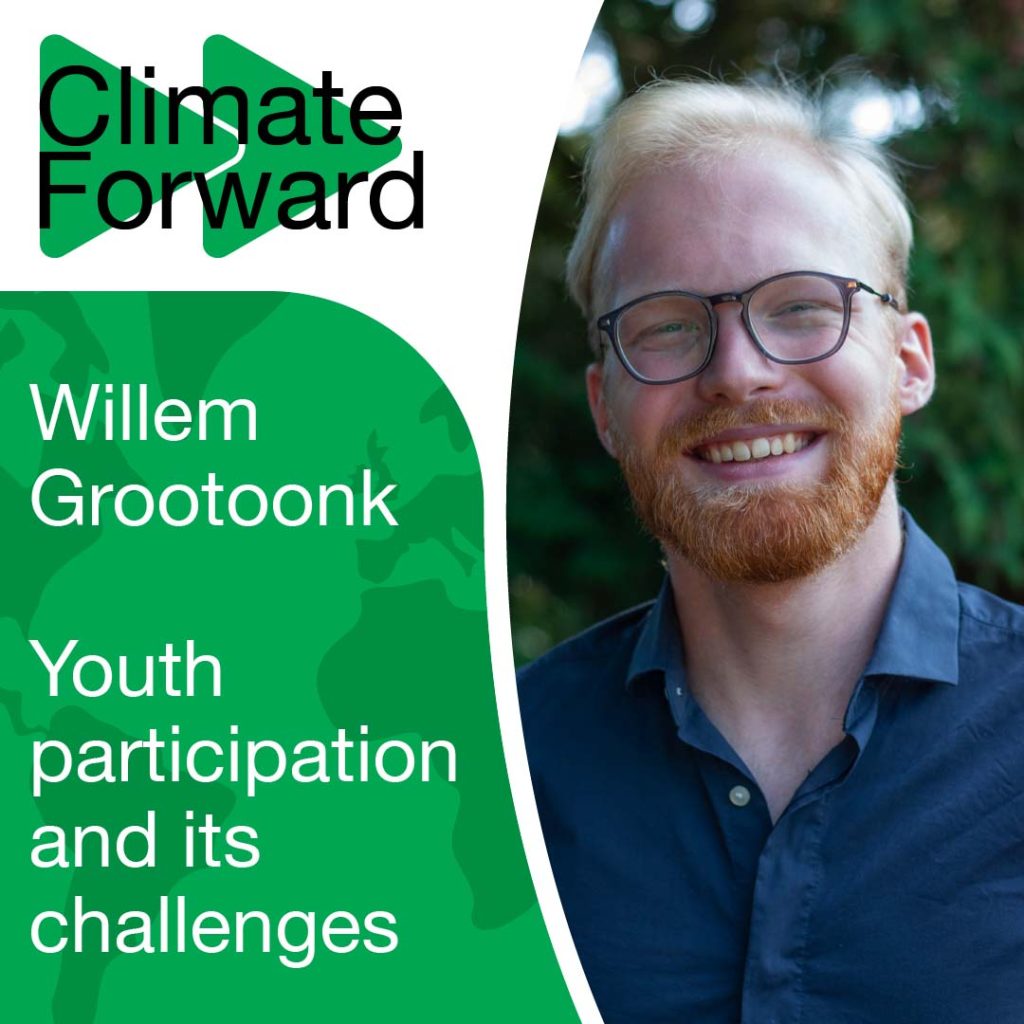
Willem Grootoonk talks about youth participation in policy, its challenges, and limitations.

Willem Grootoonk talks about the importance and the challenges that come with youth involvement in policy (and many other areas). He actively promotes the involvement of youth in environmental policy at the Dutch Youth Environmental Council.

Show notes

Willem Grootoonk is a European Climate Pact Ambassador, a former e-sports commentator, and the former Chair of the Dutch Youth Environmental Council (Jongerenmilieuraad), where he is still active as member of the Advisory Board. Willem talks about the importance of youth participation and the challenges that need to be overcome for a proper implementation of youth participation in policy making of any area.
Willem Grootoonk on LinkedIn

Dutch Youth Environmental Council (Jongerenmilieuraad)

Transcript

Mansur: 00:05
Welcome to Climate Forward, the podcast where we explore the actions and stories of the European Climate Pact ambassadors. My name is Mansur Philipp Gharabaghi, and I’m your host. In this episode, I speak to Willem Grootoonk. Willem is a European Climate Pact ambassador, a former esports commentator, and was the chair of the Dutch Youth Environmental Council.

Willem Grootoonk: 00:33
We want to share awareness about why it’s important to involve youth. How do you do effective youth participation? Young people don’t know the traditional ways of engaging with politics. Hello.

Mansur: 00:49
It’s a pleasure to have you here with me today, and uh we will talk a lot about youth participation because that’s a topic you know a lot about.

Willem Grootoonk: 00:57
Yes, I do, I do. Uh, and I’m uh really happy to be here to uh to talk about that.

Mansur: 01:02
Willem, you are a European Climate Pact ambassador?

Willem Grootoonk: 01:05
Correct.

Mansur: 01:05
And since when have you joined the pact?

Willem Grootoonk: 01:07
I joined in the beginning of 2021 when Fons, the manager, director of the Benelux Pact, approached my old board, the Jung Breurat, the Dutch Youth Environmental Council, to see if we were interested in joining. And then I initially joined representing my board, but I kind of stayed because I liked it and I found it an interesting way to kind of stay involved with the whole policy arena and just climate action in general.

Mansur: 01:37
So you joined from the youth participation uh council, or what was that?

Willem Grootoonk: 01:42
Yeah, so I used to be the chair of the the Dutch Youth Environmental Council or the Junge Milieuraad in Dutch. Um, and it’s uh an organization run by young people, um, and we work together with the Ministry of Infrastructure and Water Management to um yeah represent young people on topics related to the environment, so we did the stricter definition of environment in that like soil, water, air quality. Um and um yeah, I I did that uh for a year. Uh I’ve uh left that since to do other things, but uh yeah, it that’s how I got to know the pact, and I’m really happy to be still involved. It’s uh it’s a very interesting organization.

Mansur: 02:25
I would like to stay with the topic of the youth participation uh council. Can you explain? So it’s working with the Ministry for the Environment in the Netherlands. Uh, and what is the purpose of this council?

Willem Grootoonk: 02:38
The council was originally founded uh because there was a certain desire from uh the ministry, specifically like the team uh like national environmental program, it’s like future environmental policy um for youth participation, but in a way that was uh balanced, so uh not necessarily from one viewpoint, and that’s how uh during the corona years uh the Youth Environmental Council was really founded. Um, we are in principle uh or yeah, we’re like an independent organization, so we don’t work for the infrastructure and water management uh ministry, but they do give us some money. Uh, and we’ve been trying to develop like a good way of representing the opinions of young people and directly translating that to policy advice. So uh more at the policy level, so at ministry level, not necessarily at like politics level, like not necessarily lobbying, I would call it. And we focused on milieu uh because it’s a bit of an underlit topic, often uh it’s often forgotten, uh forgotten about in contrast to the much more popular climate uh topic. Um, of course, they’re massively interrelated.

Mansur: 03:52
And can you mention or or share with us one or two things that uh that you did during your time there?

Willem Grootoonk: 03:58
Yeah, I think two of the most important projects that are not finished, uh it’s still a work in progress. The first is the generation test, it’s like the generatie toets in Dutch, and it’s a proposed kind of mechanism to test uh new laws to see what kind of impact they have on future generations. Uh and there’s it’s a broader movement, it’s not just us. Um, but we’ve been trying to make that work to kind of prevent legislation from uh offsetting current like damages to future generations as a legal instrument. Uh that’s still very much in early phases, but that was very interesting to work on. And our second big project is the is a participation tool. Uh, it’s like an app that aims to uh facilitate gathering opinions from young people, like a diverse group of young people, uh, about uh environmental topics in a very accessible and non-government language way. Uh so um that’s also been a really big project. It’s almost I think it’s almost done now. So we’re actually going to uh to schools to test it out. Um, so yeah, that would that those were the two main projects.

Mansur: 05:11
So it’s a little bit about awareness raising for for the you know the topics that young people would care about, but on the other hand, also making sure that young people are included in the things that are done on the ministerial level.

Willem Grootoonk: 05:24
Yeah, so it’s like a direct involvement because we were we were directly involved within uh this specific team within the ministry. Um, like they we we gave feedback on the writing and on the policy documents and stuff, um, but also awareness creation, of course. It was not never our main goal because there’s many other organizations that do it, but it’s of course always a secondary um process. I think what was a very important goal of us is creating awareness about youth participation in general because we were one of the first kind of youth environmental councils in Europe. Um, it were by this point also one of the older ones, and it’s still very much a growing thing. So that was also what we wanted to share awareness about why it’s important to involve youth on climate topics, environmental topics, but also many other things that that we think youth have good opinions about.

Mansur: 06:20
And so, this is why is it important to include young people? I mean, in your opinion?

Willem Grootoonk: 06:24
Because you could also say there’s people in the ministry, you know, there’s scientists that do studies and I think because they’re very unrepresented, because young people don’t uh know the traditional ways of engaging with politics as well, i.e., they don’t go vote as often, um, they don’t uh know their ways to uh the ministry as people that have a bit more settled network tend to be. So I think by the way we organize our job uh structure in the policy arena, young people are always less represented, even though um yeah, and a large part of them can’t even vote. So that’s also important to note because there’s also a lot of young people that are not 18.

Mansur: 07:04
Um, yeah, sorry, maybe maybe uh a question in between how do you define young people?

Willem Grootoonk: 07:10
Yeah, that’s always a good question. Uh, we did um anything up to uh I think the official one was like 2029 or 30 or something. I we never really used a very consistent uh like part for it because I feel like it’s one of those things if you feel like a young person, you are a young person, right? So we’re not gonna say to someone, oh you’re uh you’re you’re 35, you can’t join anymore. Um it can’t it kind of figures itself out. It’s uh it’s not really that we’re only looking for high school, high school age, for example. Um but I would say the majority of the people that engage with these kind of topics are like in the 18 to 24-5 range within our organization at least.

Mansur: 07:58
You know, we talked before we started the recording, and you mentioned challenges um in youth participation, uh, but also is youth participation in particularly the council that you mentioned, uh, is this really set up to make an impact, or is this just something that some people feel is nice to have?

Willem Grootoonk: 08:16
When I was chair, this was one of the main uh questions I had for myself uh as and for the organization because of course I became involved at a later date, so the idea of the organization was already there and it was mostly set up. Um but you really I really had questions about like how do you do effective youth participation and is it even possible? Um and yeah, I’ve also faced some some challenges uh of course during the year with with realizing that and uh often realizing that it doesn’t work. I think a good example is quite often you’ll get invited to these events, and they’re mostly events for like their conferences and or something like that, policy events. Um, and they invite a couple young people, usually no more than 20. Um, and they we always felt like we were like the token young people. Like they they they invite you, and you’re like, oh go look, go look happy and engaged, and uh then we can show everyone that visits our conference how how well we’re engaging with uh with young people. And I’m not saying that all the conferences we went to had this because there were a couple good ones, but there was also a couple where you felt like yeah, why are we here?

Mansur: 09:28
I think this is in any way a bit of the challenge that you are that you’re facing with young people participation. On the one hand, the danger that you know your people or organizations invite them to make the event or whatever they’re doing look more inclusive.

Willem Grootoonk: 09:43
There’s a name for it, it’s like young washing, I think it’s called. It’s like greenwashing, but then with young people.

Mansur: 09:50
I would like to deep dive on the topic of you know token youths a little bit more in a second, but before we go there, I’d love to take a step back to what you mentioned before this generation test. Yeah, that sounds very, very interesting to me and also really relevant. So, can you explain this a little bit more?

Willem Grootoonk: 10:08
Yeah, I I was not personally involved with like the intricacies, um, but the idea is quite old, uh and it’s it’s basically a legislative mechanism. Like laws already have to pass a bunch of like controls, and the proposed one would be that there’s additional control that the law does not um like move any of the burdens of current legislations upon future generations. Um, so for example, um some laws they say uh we save money now by doing this, but what they’re actually doing is they they’re moving often environmental costs to the future, so that as people living 50 years from now will actually have the cost. Um and the I think the main strength of such a tool is that like of course we have a politic political system with four-year terms, um, so on the short term, there’s very little incentive to uh, or there’s a actually that’s wrong to say, there’s a lot of incentive to move uh negative uh side effects to the future because your voters it doesn’t matter for if you’re voted in or not, uh as if as long as it doesn’t happen within the next four years. Um and I think a test like this could like help with reducing the effect of like the very uh short-term nature of policy, but it’s a very difficult thing to implement because there’s already a lot of legislative checks, it’s already a lot of paperwork to get a law done, so there’s some resistance surrounding that. Also, how where do you set the boundaries? Like, what is like how does how can you measure such a thing, and how should the the the like certain damages or certain expected damages be calculated? Uh, can uh a simple tool do that, or would you have to do a research paper for every law you’re trying to pass? Like, there’s a lot of questions, but I think the idea of it is very important to look into, and we’ve been doing that together with uh the the SAR, so the the the Social Economic Council, I guess. Like it’s a really big found advisory body in the Netherlands, and uh Jacob Bey has been involved, so the young climate movement translating everything into English here. Sorry. Um so yeah, that’s been a really big collaborative process, and it’s it’s very interesting to work on, but uh I wouldn’t expect it soon.

Mansur: 12:34
Um, and you mentioned youth participation is as a topic in the beginning. I think it’s really hip at the moment.

Willem Grootoonk: 12:40
Yes, everyone wants one.

Mansur: 12:42
Yeah. The question is, is it really working?

Willem Grootoonk: 12:46
I would say right now uh that it often does not work. Um in my experience at least, uh, policymakers are willing to listen to you as long as it’s within their comfort zone, and as long as you’re not not saying anything too controversial, they’re willing to take your feedback. Um, but the moment that your interests start to significantly differ from theirs, the there’s suddenly less interest to do youth participation, and there’s not necessarily any single organization, and I also don’t think that people actively do this um like out of malpractice or because they they they don’t think uh like you young people are have the same valued opinion. I think it’s just also um like young people don’t vote as much, so at some point it doesn’t become as politically interesting to to represent them as much anymore. Um but it is a very interesting discussion. How do you make it work? I think that is a more productive question than to to ask what does it work now or not. Uh and yeah, that’s uh I have some thoughts on that. I don’t have the the the secret answer, unfortunately. Otherwise, uh I wouldn’t be doing something else right now.

Mansur: 14:01
But it is something that you also I mean you see it in in every you know, every area where people try to do something that is inclusive, right? Yeah. Also the European Climate Pact, which you know that brought us here together. That’s also an initiative that tries to gather people from all areas of the society. Yes. Yeah, I I my feeling is that there are at least some struggles to really reach everyone.

Willem Grootoonk: 14:27
Yeah, no, I we talked about this earlier as well. I think there’s the way that the policy arena works, and especially like the kind of volunteer policy advocacy part of the whole thing, like it’s very close related to class, and um I think there’s some inherent barriers that would be very hard to get rid of because if you think about it, the only people that have time to volunteer for let’s say the Youth Environmental Council and spend like their hours uh talking and trying to improve youth and like youth and participation and trying to improve the parliament, uh like environmental policy. Um and same can be said for the climate pact to to go through like these podcasts and go through events and speak there. Like the only people that have time for that are usually uh students because they have a lot of time, um, and they don’t have to like if you have the financial space to not have to work next to your degree at least, uh you can do these kind of things. Um people that already have um like a good financial backing and uh a good financial position, so they don’t need to like they don’t need to worry about other things. So yeah, I think you can be very open to uh everyone, and I think that you should. Um but you shouldn’t expect people to show up by themselves. Uh we had a big of like a lot like the Youth Environmental Council. We really actively try to be as like open to anyone who applied. Like we at some point we had like almost no application requirements except you speak uh you could speak Dutch. Um and yet um it doesn’t naturally come. Like the natural group you attract is usually university students that already have an interest in a topic, uh, the the environmental bubble we would call it sometimes. Um, and bursting that bubble is is tremendously difficult.

Mansur: 16:27
And that makes it then very difficult, I imagine, when people come and claim that they’re representing a particular opinion of a certain group, be it now young people or or anybody else, right? I mean, how can we make sure that the opinions we get from representative groups or from representation groups really include everyone?

Willem Grootoonk: 16:47
Yeah, it it’s a really big challenge, and I think that’s not like often it doesn’t happen in a very good way right now, but um of course you never actually talk with all young people because the only people you ever speak to, or ever, but you mostly speak to people that are interested in climate and that are usually a middle or higher class um have have like free time. Um and there’s ways you can get around it, but I think the most important part is that you are aware that this uh this this inherent gap exists. Um and that uh you should take like take take care to and acknowledge it in any results that you have, uh, and to to be very careful with what you say when you’re making general statements about what young people think. Um because I think this it’s a very hard thing to solve.

Mansur: 17:45
I think this is that’s actually a very good point. I really agree with that, right? I mean, it is okay to have biased opinions, or we all have biased opinions, but the key is that we become aware uh that this may not be as representative as we think. At the same time, I do think that when we talk climate, when we talk environment, that the actions that people take based on maybe not a fully representative opinion are most likely going in the right direction. I mean, we all know it is a really good idea to make sure we don’t put more CO2 in the environment. We all know we need to take care about our methane uh emissions and and and so there are certain areas where you could generalize and make sure that it’s the benefit of the bigger group that you’re you’re no that that’s all that’s a very good uh thing to say that there’s um a contrast of interest there.

Willem Grootoonk: 18:42
Like it’s it’s a bit of a a dilemma because, in the one hand, of course, you want to improve the climate and you want to do improve environment, and you want uh, as someone who works in the environmental kind of bubble, you want to prevent future climate damage, and so you want to push this topic really hard because that is your personal conviction, and I believe that this is also in the benefit of the group I’m trying to represent, but that is my own belief, and on the other hand, you want to be as inclusive as possible and actually be representative, but then your process is gonna be way slower because you keep having to uh ask people for their opinion, and your the opinions might not be as nice and streamlined as you want them to be, uh, they might not be as uh convincing because saying, like, oh, 55% of young people is interested in doing this climate action, it just doesn’t sound as like strong as uh a very a higher number, for example, or like a majority, or so balancing this this between like advocacy and trying to get climate action done, which I think the climate pact also does, um, whilst actually representing young people, the it’s a it’s a tricky balancing act. Um but that that kind of goes back to the point also where it’s good to be transparent about it. I think any route you take is fine. Like I think there, like, for example, the the youth uh climate movement, they’re a bit more activistic, they take a bit more controversial standpoints, and I think that’s completely fine. Uh, I think there’s a high need for that, even. Um, the same could be said for organization organizations like Extinction Rebellion. Like, I’m sure that not every all young people in the Netherlands share the opinions that Extinction Rebellion has. Um, but um there’s still a value in the agenda setting uh action that they bring. Um yeah. But I have problems when such organizations say that they speak like representing all young people.

Mansur: 20:57
How inclusive does our decision making on policy level have to be, right? I mean we do have scientists that focus on different areas. Like when we talk climate, there are scientific uh goals that have been set forward. We have to achieve them, and I don’t think this needs to be based on a majority of on a general opinion of the public. I mean, the scientific targets will have to be met regardless whether everyone agrees on them. Yeah. Because it’s, you know, either we destroy the world or we don’t. I mean, yes, there are people who think otherwise, but in principle, this is you could make it as black and white.

Willem Grootoonk: 21:33
And most people agree with that. There’s actually this is unrelated, but uh a surprising majority of people actually believe climate change is a problem. It’s often underestimated.

Mansur: 21:43
I think this is one this is exactly one of the things, right? I mean, uh probably like you said, a lot of people agree with that, that we need to do something. Not everyone has the chance to get involved in it hands-on.

Willem Grootoonk: 21:54
Yes. No, I agree. I don’t think it should be an end goal to be 100% representative because it’s a bit of a sissy task, so to say. Like you’ll it’s like a an unachievable goal, and uh if you lose uh like your strength trying to reach it, that would also not be good, uh, but I think like from a from our perspective as a as a youth organization, what we did is like in in developing this participation tool, try to be as aware of the the the biases and your positionality as possible, and then really try your best to think around that. And it’s really hard. Like, even writing in uh Bay Ain like B1 Dutch is really hard already for someone who has been in academia for a while already.

Mansur: 22:45
Sorry, I’m not sure everyone is aware, but these are the the different levels of language proficiency in the European.

Willem Grootoonk: 22:51
So officially, the the Dutch government aims to communicate in B1 level Dutch, which is really basic Dutch. Um, because a lot of um government language, so to say, is just not readable, and this really does not happen. What we really aimed at is going to places where there’s already structures that are mixed, and specifically high schools, because the way the Dutch high school system works is that they’re relatively mixed, of course, you’ll have some geographic differences, but uh compared to the natural way of engaging with people, Dutch high schools are quite diverse, so that’s why we really want to go to many schools because that way you don’t have the like that people have to volunteer to give their opinion because then you’re already selecting. Um, so that’s that’s our idea, and it could be one way to to at least promote uh inclusion, but it’s probably not a real fix, of course.

Mansur: 23:54
But it may be a step in the right direction, and it brings us actually full circle to one of the tools you mentioned in the very beginning, yeah. Uh, namely this uh the participant participati tool, yeah. Yeah, um, I think before we round off, I would really like to know a little bit more about this and how the idea uh to develop this you know came to fruition.

Willem Grootoonk: 24:14
Yeah, so the idea we wanted to have like a a streamlined way of collecting many opinions, uh, but in a way that uh you have as like little possible response bias. So where we’re because if you just put it online, let’s say we put it on the Junge Milieuraad.nl, and people can fill it in, you’re only gonna get responses from people that took the effort to look up your website, and those people already care about climate, and they’re also not people we aim to reach because they are already quite well represented. Um, so we were thinking of creating something that did allow us to easily gather data and work with it. Uh, but on the front uh is something that’s very powerful to use. Um in, for example, if you go the way you want to use it now, this was not always the idea. Uh use it as a tool in like a classroom setting. So you go to a school and you teach, uh you provide a class uh setup, and then during the class you use this uh participation tool, and the way it works is there’s a bunch of prompts, and the prompts are uh animated with the line’s cute little frog. And the frog basically uh it’s something like, Oh, uh your phone broke. Uh and then uh what are you gonna do? And then there’s a couple slider options of uh buy a new one, get it repaired, something like that. It’s a really simple answer. There’s a bit more uh like advanced ones in there. Um and the idea is that this would be then a bit more of a like an accessible way of gathering this data without relying on uh people to like take action themselves. Um we still have to really think about how it will work, and I think doing it in practice will also work in discovering that we took one we did one like practice class, or not one, but the first practice class I was involved with with. Um you really notice how people want to give their opinion, and it’s often different than what you think when you design an app like that. For example, one of the the kids who was there, I think he was 15 or 14. He said something, yeah, uh we we get sent so many surveys, no one’s gonna fill them in. Um, so you also have to give us something back, and then we ask, yeah, is that money? Or I mean that that could work, uh, but also just value or attention. Uh it was very valued that you actually put it into a program, uh, give some information and go talk with people. Um, also, very important. I I guess this is a tip for all youth participation or just participation in general, uh communicate back what you did with it. Because there’s so much advice and input gathering sessions, and uh there’s many organizations that are guilty of this, including our very own government, um, and then you never hear anything from it again. Um, and that’s just super frustrating, and uh people will do that a couple times, and and then they’ll stop because they’ll be like, Yeah, this has no impact, like this this is useless. Um, so this is also what this um this uh this high school um kid? That’s not very respectful. Um this high school uh high school youth uh told us, and I found it very interesting because we had like as so like we’re we’re young people, we’re students, and we had an idea how to do this, but it turns out that our idea was already kind of off-tune with the the like the targeted audience. So yeah. It is it’s very interesting to work on it. You learn so much from from just developing an app like that about how many inherent biases you have as a as someone who’s been in the university cycle for a bit. Yeah, it’s very interesting.

Mansur: 28:19
I I think this is a a great point to to round off on or to to finish our our talk because I do think it’s a topic we could spend many more hours discussing. It’s challenging, it’s really important.

Willem Grootoonk: 28:31
Yeah, but I think one last thing to say is that it can’t really hurt either. Like even if you do it wrong, like except maybe the only exception to this is like that you’re trying to like youth washing, what we’re talking about earlier, that you’re using young people to make yourself look better. Um but if all else fails, it it is at least a good entry point for people into the policy arena. Uh it’s nice for their CV and it gets people engaged with with like a potential working field. So that like that that’s already the base level. So if you if you are an organization and you were thinking of doing it, um do try, but uh contact an organization that’s already doing it and ask them how they did it. I think that is uh my advice I can give to anyone that wants to start a youth council.

Mansur: 29:22
But I like that you said, you know, it better do something than do nothing. And if there’s if there’s someone out to to ask, please do.

Willem Grootoonk: 29:31
So yes.

Mansur: 29:32
That holds true for the European Climate Pact too, I think.

Willem Grootoonk: 29:36
Yeah, of course. No, it’s it never it’s never good to reinvent the wheel when it’s someone else has already like has a setup. Uh perhaps it’s there’s probably also better to join up instead of making up a million youth councils, which is a a process that is happening right now. Um, but that’s another discussion for another day.

Mansur: 29:59
All right, I think uh we’re A little bit at the end of our time here. Um, I want to thank you very, very much, uh Willem, for taking the time to discuss this definitely controversial topic with me. I think it’s really relevant in the area that we’re in. So thanks a lot.

Willem Grootoonk: 30:15
Thanks for having me in uh in your beautiful studio in uh The Hague. Oh, and um, people should go vote.

Mansur: 30:25
You just listened to Willem Grootoonk, who talked about the importance and the challenges of youth participation. If you want to hear more about the European Climate Pact ambassadors and their actions, subscribe to my podcast so you don’t miss out on new episodes

More episodes