Energy Globe Awards 2022 part 2: MPREIS and Take 3

Meet two winners of the Energy Globe Awards:
MPREIS from Austria has implemented the complete technical and organizational hydrogen value chain. Hydrogen is used to generate process heat and the operation of heavy fuel cell electric trucks.
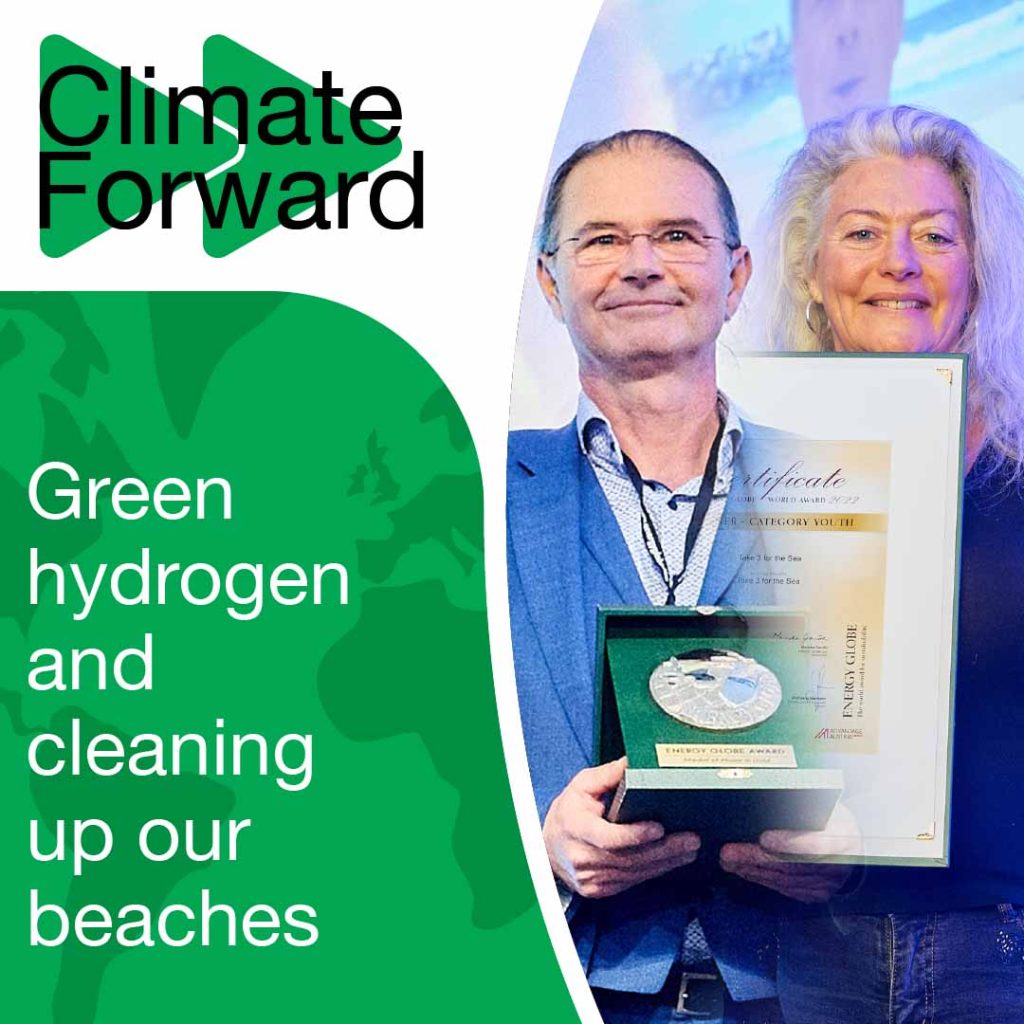
Take 3 for the Sea is a global initiative from Australia that uses cross-border awareness raising and training to make young people aware of the upcoming environmental problems and they are motivated to behave in an environmentally friendly manner.
Transcript

Mansur: 00:04 Welcome to Climate Forward. This episode is part 2 of a two-episode series about innovative projects from the Energy Globe Awards. In this episode, you will hear about Empreise and Take 3. MPRIES is an Austrian family-owned grocery retail company that has pioneered sustainability with, for example, their passive house supermarkets. With us, they share how they implemented a hydrogen value chain from production via photovoltaic and an electrolyzer to use in their power needs and as fuel for their heavy trucks in distribution. Take 3 is encouraging everyone to take three pieces of rubbish with you when you leave the beach, waterway, or anywhere. Through education that inspires participation, Take 3 is building a global movement of people who are connected to the planet. My name is Mansur Philipp Gharabaghi, and I am your host. Maybe you could very briefly explain what it is that you do. Ewald Perwög: 01:18 Yes, um, thank you very much for the invitation. What we are doing uh uh we’re doing many things, but uh uh regarding the hydrogen project, our entrise uh hydrogen initiative. We are decarbonizing our enterprise, and we developed the project from this uh idea coming from our business focus. So we are a middle-sized company, uh 6,000 employees, uh, 800 million euros turnover, and uh we are in the food retail business, is a very energy-intensive business, not just only in the core, uh with um cooling and uh and all the markets, but also in the production. We have production facilities, a bakery, and a meat processing plant. And uh Empries is a family-owned business and has a long-standing reputation for taking care uh not only for uh regarding the environment, but uh we are a local business. We are in Western Austria and we are running 300 markets, and so there are there are many initiatives that have uh been predecessing what uh we’ve been doing with uh hydrogen right now. And the idea was that we said, okay, now we have photovoltaic plants, uh, we did a lot of efficiency measurements, insulation, we’re using uh renewable energies, but uh especially hard to abate sectors like uh public transport. We are running a fleet, obviously. We’re in the distribution business, meaning we have a big warehouse uh where we commission all the goods, and every day one or two runs to every market to supply the markets with our food. And uh diesel is hard to abate, as we all know. And so um the project’s been going for seven years now, and uh so first uh considerations were in 2016, where we said, okay, now what can we do with our transport and how can we tackle our carbon footprint? And then we said, okay, we have huge consumption of natural gas and uh diesel, so we need to do something about that. Because uh we are located in the Alps and we have uh a quite abundant supply of renewable energy from uh hydropower. Uh but then again the other fossils were the problem. And so we uh investigated and we found very um clearly from a technical organizational perspective that uh battery electric vehicles would not be suitable for our fleet, uh, but we needed to um put our bet on uh fuel cell electric vehicles at the time not available. Mansur: 03:58 And why do you why did you refer uh consider EVs not suitable for what you need? Ewald Perwög: 04:03 I compare it sometimes to tools. You know, you uh there is this raging uh discussion about what is the better technology, either battery electric vehicles or fuel cell vehicles. And I’m I’m my argument is uh what is a better tool, uh a hammer or a screwdriver? Nobody could say that because you need it for different purposes. And battery electric vehicles they have advantages and disadvantages, very similar to fuel cell vehicles. And if it comes to range and weight, we investigated very closely and we found out that battery electric vehicles could not uh provide the solution we need. Our average daily uh transport is 400 kilometers, so over the entire fleet, and so we calculated this with uh rechargers at the at the delivery stations, and uh so we really dig dug in very deeply uh just to find out that uh battery electric vehicles will not be capable, and and that was uh and that was the case in 2017, and it’s still the case in 2022. Mansur: 05:10 I would like to take a step back and go back to the beginning. So you said um your your company is in the food business, but also there’s a big distribution part of it. Um, but and I know that a lot of companies are looking at uh how can they get more sustainable? Uh but what was the motivation for yourself? Because you told me just now that it started several years ago, so quite a while ago. Ewald Perwög: 05:32 I mean, if you go to the root of it, then uh let’s talk about the limits of growth 1972. So I was born 19 uh sixty-eight, and uh all my life I’ve been uh witnessing the calls to action in vain so far. We have not succeeded, we haven’t uh been able to restructure our system in such a way that uh uh we are living in a sustainable world, and uh, and that’s becoming more and more of pressure as time goes by, and especially uh like after the turn of the millennium, uh it became more and more clear that it need something needs to be done on a massive scale. And as a as a person, you are in your environment, and then you try to contribute whatever you can in your own environment. And in our environment, with MPIS and with uh uh the ownership uh being in uh a family of conscious people, uh, there was this chance to develop solutions, to come up with solutions, and to show to the world uh how uh this could be part of the solution. And and that was the motivation for our big uh photovoltaic uh project, which was a predecessor. It was also the motivation for our passive house supermarkets, that’s what we call them, uh, where we try to do uh uh design in such a way that uh our energy consumption is minimized, and so you can uh trace this back now for more than two decades, and uh and the hydrogen turning point, which arrived for us in 2017 when the Horizon 2020 project was initiated, which is on the foundation of our initiative, uh, where we decided that. And of course, we I was uh promoting that at the time very heavily and was able to convince uh the owners that this is the right step to be taken. Mansur: 07:25 I believe that this is I mean, particularly Empress is a profit-oriented enterprise, right? I mean you need to make money. So uh could you very briefly also explain how financially does this make sense for you? Ewald Perwög: 07:36 Very often I’ve been asked when does it pay off? And uh I came to answer always it pays off immediately for our children and for our environment. Yeah. But to make a more clear, a more clear point is that it is impossible to seriously put down a uh recuperation figure or any payback time for such a project because the framework conditions are not yet set. But what can be done, and that was obvious, and that’s been obvious for many many years, is if you look at it in a different way, uh you look at the climate catastrophe and it’s unfolding, and then you see that every year a little bit more, a little bit more, meaning that it’s inevitable to get rid of fossil fuels. There is no way that this is not gonna happen. And uh betting on the sane minds of uh European Commission politicians but also local commission local politicians, you have to say if you are able to implement and if you are going uh this road to decarbonization, it will pay off in the end. It’s not yet clear when it will pay off, because this depends on uh when society is able to put the framework conditions in such a way, external internalized external effects, internalize um um the destructive effects of uh carbon dioxide pollution and so on and so on and so on. And so that means if you are if you have a decarbonized uh enterprise, or if you are like we now um trailblazing, if you want to say so, uh then you can be sure that you’re on the right side. And then it’s just a question of sitting it out, so to say. So meaning to trade off the short-term benefits of polluting and doing business as usual for investment now and having a less painful road ahead after. Mansur: 09:38 I do want to come back to the aspect of cost because you need to keep making money so you can pay your employees and keep producing your products. Um, this project has it increased costs, or are you able to say, you know, with gas prices and what we’re seeing in the market, we are confident and we can we’re still competitive with the prices and the costs of production in our in our company? Ewald Perwög: 10:01 I mean, uh regarding costs, as you as you indicated, there is the opex and the capex. Yeah, and the capex for our project, as I said, uh we have invested all together with funding with grants uh around about 13 million euros. Uh for an enterprise with an annual turnover of 800 million euros, that is feasible. Yeah, it’s not a neck-breaking uh risk. Yeah, so that is the CapEx exposure. And then the OPEX exposure is something that is very much depending on the timeline. So that means now we’re in the position that we have implemented the entire value chain. We have an electrolyzer, we produce green hydrogen, we can store it, we have a hydrogen refueling station for um commercial vehicles, and we have a so-called dual fuel burner that is capable of producing industrial process heat uh carbon-free by burning hydrogen. So that is all set in place. Concerning OPEX, obviously it’s clear that with the skyrocketing prices of fossil fuels, also electricity prices rose. We know this. This is about the merit order principle. If if gas-powered plants can come in, uh they set the price, and so electricity and fossil fuels uh went up in parallel. And so the for us, the the the earnings situation would increase dramatically if the gap between electricity and fossil would widen. So if electricity, if renewable electricity becomes more cheap in comparison to fossils, then our business case starts to yield. But this is also a question of uh quantities. And for now, since uh in two weeks from now we are expecting our first heavy-duty fuel cell truck, we are producing very little compared to the nominal capacity of the plant. And that means that we can resort to uh weekends or night times where we have uh uh given uh mostly through the intermittent character of renewable energies, we have uh lower prices, cheaper prices, and there we can produce hydrogen uh cost competitive to uh the substitution of natural gas in the natural heat processing. And for the substitution of diesel, it’s much uh more difficult. Um, let’s say giving a diesel price of let’s say two euros per liter, roughly um to have a cost equivalent uh on a truck. Uh like let’s say the opex costs for 100 kilometers, the electricity price must not be beyond uh 70 euros a megawatt hour. And these are yeah, it’s hard to obtain. It’s a couple of percentage every day or every week of hours where this is feasible, and outside that it’s not. Mansur: 12:54 I want to touch uh on uh on one more subject before we close off, and that’s uh the um efficiency of the process because I know this is something that’s quite particular with uh your process that has an extremely high uh efficiency coefficient, right? I mean, normally maybe you could explain this a little bit and how you arrived there. Ewald Perwög: 13:13 It’s a very important question. And uh, in our um like uh let’s say profit-driven economy, uh efficiency is very often uh equivalent, and here is the same case with profitability. And so there is a huge emphasis on efficiency, but if you look at it from a technical organizational perspective, you have technical efficiencies, and uh, with an electrolysis uh process you have an efficiency of round about 70%, meaning 30% of the input energy is converted into heat. In order to avoid the efficiency debate, yeah, but there was a time when I was coming up with this idea or with this example. If you are sitting at home and your house is on fire, yeah, then you do a couple of things. You eventually call the police and you start um uh extinguishing the fire. But you’re not gonna sit back on your couch and say, I wait until fire brigade becomes more efficient. Yeah, you don’t do that. You act. And in order to address this problem of efficiency, which is a problem of profitability, we have decided to recuperate the heat that is being produced in the electrolysis electrolysis process because we have like knitted together the uh our project with our production facilities. And and uh with this heat which we recuperate, we transfer to our production facility to the Bakerei Tresemelk one to our Alpenbetzgerei, where we have a huge demand on low-grade heat, and there uh we have a huge buffer tank of water. We put the heat into it, and all the heat that we can recuperate is then potentially substituting uh natural gas that we need to burn to produce low-grade heat. And this is why we have uh we are really proud on that. We can say that we have a production efficiency uh of beyond 90%. Mansur: 15:14 Well, that’s uh I don’t think there are a lot of uh electric or energy sources at the moment that can rival this. Ewald Perwög: 15:20 But it’s so easy. It’s so easy, you just have to take an additional step, put some more CapEx in, and then you have that. Mansur: 15:27 Maybe looking at the future as a final question, um you’re now implementing this for your company. Uh, do you think that your model could also be uh a model for the industry as such, let’s say for distribution or for We hope this very, very, very much. Ewald Perwög: 15:43 Because one of the reasons why we did this also, now coming to a personal motivation, if a mid-sized company like ours can do that, yeah, there is no other company that can then say uh it’s not possible, it won’t work. Yeah, and so this is how we try to contribute to and how we try to make this a part of the solution, and then and thus we say, look, we did that, and we are not a uh huge multi-billion international, we are just a mid-sized company and we can do it. And if we can do it, you can do it as well. So please stop excusing. Mansur: 16:24 I think that’s a perfect closing word. Thank you very much. Thank you very much for taking the time to talk to me. Thanks. You just listened to Ewald Perberg from MPRIS. He shared how MPRIES is implementing a hydrogen value chain in the company. Next, I will speak to Roberta Dixon Falk from Take 3. Roberta will share how Take 3 started and how they are trying to motivate everyone to take three pieces of rubbish with you when you leave the beach, the waterway, or anywhere. So, um, hi Roberta, thank you very much for taking the time to talk to me today. Roberta Dixon-Valk: 17:00 You’re very welcome. Thank you for taking the time to ask me about Take 3. Mansur: 17:05 We are here at the Energy Globe event where the Global Awards will be handed out, and you are nominated with your project Take 3. Um, before we dive into what is Take 3, I would like to understand a little bit which problem are you addressing and what personal motivation uh stands behind that? What made you take this up? Roberta Dixon-Valk: 17:28 So Take 3 looks to address the problem of plastics in the environment and specifically in the ocean. The ocean is downhill from everywhere, and it’s a beating blue heart of our planet, so we really need to take care of this beating blue heart that keeps us alive and well. And um, so what we do in with Take Three, we’re actually it’s a call to action. We’re actually asking everyone to take three pieces of plastic from the beach, waterway, or wherever they find themselves and dispose of that rubbish responsibly. And what what that actually does is enters it opens people’s eyes, and they actually you start to be able to converse with people more broadly about their own plastic footprint. So it’s a really good opportunity of just opening the door to how much plastic individually we use and how to best avoid it or minimize that amount of plastic use. Mansur: 18:28 And and how did you I mean, I know when I go to the beach, I’m shocked because everywhere is plastics, uh, everywhere is residue of plastic residue. Um was that also for you the the motivation to take this up? Roberta Dixon-Valk: 18:42 The motivation to set up take three was really seeing all the plastic that was in this place that I loved, the beach. And um, my background is as a marine ecologist, and the other co-founder, Amanda Marischal. Her background was youth education. So we came together and realized that we needed to do something, and what we could do was inspire everyone to be part of the solution. And so we we developed this call to action effectively, take three and take three for the C. And that’s just the beginning of the of the whole story and the journey into plastic because once your eyes are opened, you can’t unsee plastic in the environment. You just see more of it. And so once you’ve seen it in the environment, so once you’re aware of plastic and it being out of context in natural environments, you then start looking at your own plastic footprint. Mansur: 19:43 I think that’s an excellent bridge to explain a bit more what take three actually is. Maybe you can just line out what’s the idea behind it. Roberta Dixon-Valk: 19:52 So take three is a call to action. We’re asking everyone to take plastic from the environment and dispose of it responsibly. What we want everyone to be aware of is that it’s our individual plastic use that is resulting in this catastrophe, a crisis. It’s a plastic crisis that we’re witnessing all around us, and we want everyone to take control of it and take responsibility for it in their own way. So we ask everyone to take three pieces of plastic, dispose of it responsibly, and then start thinking about what they can do to change the status quo. Mansur: 20:32 So there are two sides to the idea, right? The one is take three pieces of plastic with you when you go somewhere from the environment, take them out. But at the same time, I think you’re also working on awareness creation and education around plastic and plastic pollution, correct? Roberta Dixon-Valk: 20:47 Absolutely. What we want to do is we want people to understand that it is a plastic pollution crisis that we’re dealing with, and the only way we’re going to overcome that is by everyone changing their habits of consumption. We’ve just been quite rampant in the way we’ve been using plastic. It’s an amazing material. It’s strong, it’s durable, it’s lightweight, it’s cheap. And what we actually want people to do is understand that those same qualities that make plastic such an amazing material actually makes it a hazard the way we’ve been using it in the environment, because we’ve just overconsumed and overused this incredible material called plastic. And so we need to pull back and and go back to the future in a lot of ways because 50 years ago we were doing things a lot more sustainably. We I when I was young, when I was a little girl, and this is giving away my age, I’m 55. But in Australia, we used to have milk delivered in glass bottles with foil lids, and they were reused. You’d put them up at the top of the driveway and they’d be taken away, and you’d you’d end up with two new bottles of milk. So it’s not the same consumption. We’ve got to look at our consumption and the throwaway linear approach that we have to our economics. There should not be any waste. Waste should be a resource into its into and onto itself. Like we can’t look at waste as being something that you uh throw away, and there is no place. Away. Away doesn’t exist. We’ve got to actually look at the way we use and produce items. Um, and I think a lot of this comes down, it’s it’s certainly the consumer, and we can all make a difference, but it’s also the producers of products need to look at um responsibility for the life cycle of the product that they’re creating. Mansur: 22:53 I I think particularly when we talk about plastic, this is really one area where we need to become so much better as a society, also, right? Like you said, it’s an incredible material. Uh everywhere around this, around us, there’s plastic and not only packaging. Uh, but I think one of the beauties of plastic could be that if there is an efficient recycling cycle, that if we collect what we use, you can reuse it, it’s reusable, and you can give it a second life. But I think the biggest or the big problem is that we have that we use so many single-use items and they just end up in the environment, right? Roberta Dixon-Valk: 23:32 Absolutely. We’ve we’ve taken this product, this material, and we’ve just created a world around it, it seems. We we need to think about why we are making certain products in plastic and why why we can’t go back to to alternative materials that we know have been around for a long time and that they last. And we also need to look at making sure that the supply chain for plastic and plastic resource reuse is in place. We don’t want to I I think people really want to be responsible. They don’t want, they want to be able to recycle plastic, but there’s a lot of greenwashing around the way plastic is recycled. We need to have good tangible markets for plastic, and we need the the products at the end, the recycled plastic products, to be valued as much as what the original plastic material would have been had it been made with virgin plastics. Mansur: 24:41 I want to come back a little bit to the Take Three initiative. How big is Take Three at the moment? Maybe you can start at the beginning. How did it begin and where too has it grown by now? Because it’s not for nothing that you are here today. It has become an incredible initiative, right? Roberta Dixon-Valk: 24:59 So take three started 13 years ago when one of my wonderful co-founders and I came up with this simple idea which could have huge ramifications. It was just simply that if every person saw themselves as part of the solution to plastic pollution, we would be able to make traction with the issue of plastics ending up in the environment. So we knew I’m a marine ecologist and I Amanda Marischal, another of the co-founders, is a youth engagement officer. And we realized um that the simple notion of everybody contributing to the plastic pollution problem in a proactive way. I think with environmental issues, they can be really quite daunting. Whereas with the plastic pollution issue, even though it’s a major environmental issue, it’s something that we can all be proactively involved with. So we came up with this idea. If everyone took three pieces of rubbish away, we started with 10 pieces. I thought, no, everyone’s not going to take 10, maybe five. And we whittled it down to three pieces of plastic because we thought that’s really a tangible amount that everyone can remove. And from that point, everyone’s eyes start opening and we can really see the problem of plastic pollution around us. Mansur: 26:30 I really like this idea of taking just three pieces because it makes it so simple that you you cannot not do it, so to say. Roberta Dixon-Valk: 26:52 Once you’ve seen plastic in the environment, you can’t unsee it, and you really need to you you feel obliged to remove it. You think about all the animals that are impacted if you leave it there, potentially. So we yeah, I think it’s the number three was really something quite significant in terms of having traction with this in this with this initiative. Mansur: 27:15 Roberta, the initiative has become quite big. Could you share a few details how large it is by now? Roberta Dixon-Valk: 27:22 Certainly. So we’re really excited because Take Three is a reasonably small group of very dedicated and passionate individuals. And I at this point would love to acknowledge the amazing founders, my fellow founders, um, co-founders rather, Amanda Marischal and Tim Silverwood, and then all the people who have worked with TakeTree have been have played a part in growing this organization and the volunteers, but it’s our global community that’s really so significant. We have about over 350,000 people who use the hashtag take34The in 129 different countries. And those people we’ve had via research work out, they’re removing about 10 million plastic items annually. So it’s a really big and amazing impact that we’re having, but it’s we can’t do this individually. That this is all about bringing people together, and it’s all about all of us collectively making an impact. There’s a wonderful quote by a lady, Margaret Mead, who said, Never doubt that a small group of thoughtful, committed citizens can change the world. Indeed, it’s the only thing that has, and I think that reflects on what we’ve set up with Take Three. Mansur: 28:51 I think this is a lovely point to close off our conversation and a beautiful quote to finish here. Uh Roberta, thank you very much once again for taking the time to talk to me. It was really interesting to hear about your initiative and your work. And I’m uh I’m looking forward to today and uh all the best of luck. Roberta Dixon-Valk: 29:08 Thank you so much. Thanks. It’s really amazing space to be invited to join. Mansur: 29:14 You just listened to Climate Forward with Ewald Perwög from MPREIS and Roberta Dixon Falk from Take 3. My name is Mansur Philipp Gharabaghi, and I was your host. If you want to learn more about the European Climate Pact, its ambassadors, and their actions, hit subscribe so you don’t miss out on new episodes.  

More episodes