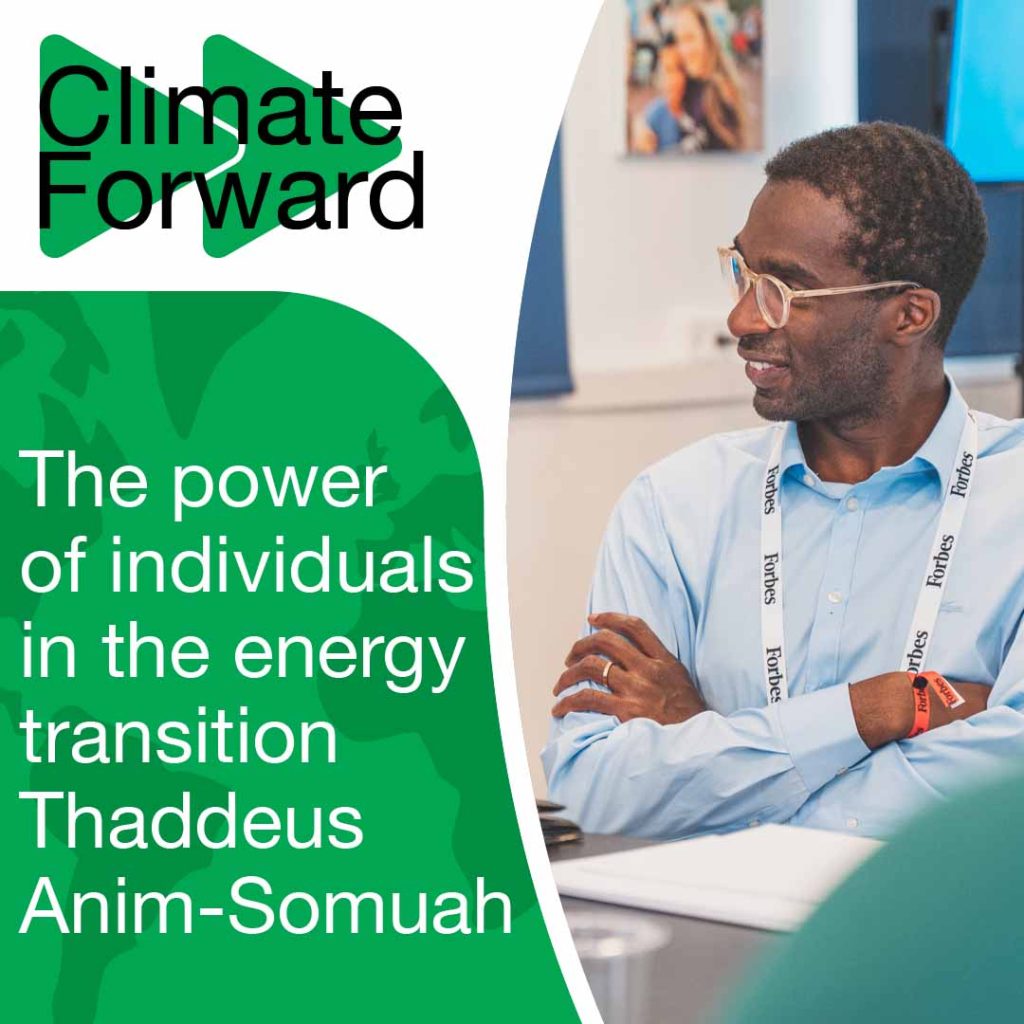
Thaddeus Anim-Somuah talks about the power of individuals in the energy transition.

Thaddeus Anim-Somuah believes in the power of individuals in the energy transition and that every cent we spend is a vote for a product and a supply chain.
Thaddeus Anim-Somuah

Show notes

Thaddeus Anim-Somuah is a European Climate Pact Ambassador and a Board Member of the Future Energy Leaders of the World Energy Council. Climate Action is one of his passions. In 2020 Thaddeus was listed as Forbes 30 Under 30 Europe for Manufacturing & Industry.

Thaddeus talks about his work at Cargill and previously Croda Performance Technologies where he was involved in the introduction of internal carbon pricing and shadow pricing.

He also believes in the power of individuals in the energy transition and that every cent we spend is a vote for a product and a supply chain. 
Thaddeus Anim-Somuah on LinkedIn

Transcript

Mansur: 00:05
Welcome to Climate Forward. My name is Mansur Philipp Gharabaghi, and I’m your host. In this episode, I speak to Thaddeus Anim Samuah. Teddy is a future energy leader at the World Energy Council and European Climate Pact Ambassador.

Thaddeus Anim-Somuah: 00:24
If you buy something in the Netherlands, it might have been made in China. So those emissions are actually happening in China. So in this way, the whole world is interconnected. Every cent that you spend is actually a vote. It’s a vote for the company and the whole supply chain.

Mansur: 00:55
Thanks very much, Monsieur. We talked before, um, I can call you Teddy. Yeah, yeah, that’s great. Great. So Teddy, um, you’re a climate pact ambassador, uh, and you’re also a future energy leader, and you also have a job at a very large multinational company. Maybe you could introduce yourself.

Thaddeus Anim-Somuah: 01:16
Yeah, uh, so we’re here today because I’m a climate pact uh ambassador uh for the EU, the grassroots movement. Climate action is a passion of mine, and that’s why I got involved in it. But it’s something that I’ve been able to translate also into um, let’s say my day job. Um, I’m an engineer. I I work at Cargill, which you mentioned is a multinational. It’s known for like agriculture and food. I work uh within this chemical uh division, and I’ve done a lot of work um on uh the energy transition within uh parts of uh Cargill and and previously uh within uh uh Croder, which was uh the performance technologies division, was acquired by Cargill. And um I’m also uh a part of uh the World Energy Council, uh, where I’m a future energy leader there. And there we really uh you know, as an NGO, we bring uh together all the stakeholders from uh the energy environment, and we uh really focus on you know humanizing uh the energy transition and and make and making it happen, really. So uh I’m just trying to translate uh different parts of my passion into actual uh results.

Mansur: 02:41
A lot of interesting activities and jobs. Can you explain a little bit? Because you mentioned the World Energy Council. What is it?

Thaddeus Anim-Somuah: 02:51
Yeah, so we are one of the UN mandated bodies for energy. Um we have members, member countries, so um more than 90 or so member countries. We bring together stakeholders when and when we’re talking about stakeholders, we’re talking about leaders uh of uh energy industry uh businesses, also uh consumers uh and uh uh within uh big consumers within the energy um government uh that we’re bringing together ministers. Um and we also have our future energy leaders program, which is kind of our youth branch or under 35 branch. I’m a board member within that, so and we get involved within uh a lot of the activities that the World Energy Council is doing. For instance, uh we are organizing World Energy Congress, it’s going to be in Rotterdam in April, but we also have uh had activities such as uh helping Aberdeen, the city of Aberdeen, create its uh energy transition uh roadmap. When we’re looking at these things, we’re assessing the performance of the whole energy system of a country, let’s say, for different countries, and I individually did a part of that for Nevin. So we’re doing a lot of different things where we bring people together in that World Energy Council. Um uh and yeah, it’s uh it’s exciting to be a part of that and and you know, really uh discuss, but also see the discussions come to action uh in some cases. So it is uh a think tank, but it’s not only about thinking, it’s really about um you know make making a change with the advice that you bring out, uh essentially, you know, uh educating, empowering, uh engaging. Um that that that that’s what we’re trying to do.

Mansur: 04:52
And that very much fits your role at the European Climate Pact as an ambassador, also, right? That’s there’s some overlaps, and you mentioned the word energy a lot.

Thaddeus Anim-Somuah: 05:01
Yes, yeah, yeah. Well, I’m generally a high energy person, so so so so it’s good. And actually, uh the European Climate Pact is something that uh is is I I’ve been more involved in uh for as an individual on the grassroots point, and and I’ve looked a lot in the energy transition as one of the key things that I’m gonna change. Also, uh circular economy. Um, but I see those things as very linked actually, um, and and two things that we really need to address um to uh you know change the narrative, change the future, you know.

Mansur: 05:42
This also impacted or this also had a role in your job, right? Before you joined Cargill.

Thaddeus Anim-Somuah: 05:48
Yeah, so within uh Croder um uh and and within Performance Technologies part of Croder, my title was Engineer Manager Projects, and one of the things that I was responsible for uh leading was um uh decarbonization roadmap. So Croder it went out and made an ambition to um half its emissions uh absolutely from 2018 to 2030. And uh this is a bold ambition. They got it um you know uh done and and checked by science-based targets. It is exactly what we need actually all companies to do. We need the whole world to do this uh if we want to achieve the 1.5 Celsius. But ambitions are all good, right? Uh the next step is okay, like let’s do it, you know, because there’s been a lot of talk, there’s been a lot of ambitions. Uh even Paris Agreement was full of ambitions, and and we haven’t seen any of the results in action yet. And and that’s where um I was lucky to be able to uh you know get directly involved with high-level people within Croder to make an actual roadmap, a plan of all of the initiatives that we needed to do. We put down how much these initiatives are gonna cost, we put down what we need to do right now, because some of them things that are there is actions that let’s say low-hanging fruit, you know, um uh efficiency, uh, whether that’s building isolation, metering, um, better control systems uh that you can do now. And and some of it is technologies that you need to invest in to and chemistries that you need to invest in to reduce inherently the energy of your process, stuff that technology that is maybe uh doesn’t exist yet. So you need to start partnering with universities now in order for that technology to be available later. Uh and you know, we take an active role in it because let’s say hoping that the government will solve it all and you’ll just be able to electrify everything is not the way. Because, you know, if everybody electrifies, let’s uh or everybody suddenly gets a hydrogen uh, you know, which also is gonna cut green hydrogen is also gonna come from electricity, let’s say. We don’t have the grid for that, we don’t have the network for that for that. Um and it’s not coming, you know. The the the we also need to drive electric cars, and we also need to think about where are even all the materials gonna come from. So the key before that you make the energy switch to sustainable energy is to first reduce the demand. Um, and and that’s what we were looking at, and also uh, you know, energy recovery initiatives um and and things like that. Um, and you know, uh really also looking at partnerships, partnering with sometimes companies that would traditionally be competitors, you know, uh in order to you know realize these joint ambitions together. Really, really exciting stuff.

Mansur: 09:13
Uh I think these are exactly the steps that many, many more companies need to take. Uh and you were talking about emission reduction. This is I think very, very often you can link this to uh uh energy transition. Uh what sources of energy do we consume? And uh maybe you can talk a little bit more about uh the topic of energy transition because that touches upon your role today at Cargill. It touches upon your role in the um in the NGO, the World Energy Council, as a future energy leader, and it touches upon what you are focusing on as a European Climate Pact ambassador. And I know these are three things. Let’s go through them step by step, because I do think that is a really interesting narrative that we’re we’re going to explore here together.

Thaddeus Anim-Somuah: 10:02
Yeah, so um basically when we’re talking about the energy transition, it’s really uh all comes down to reducing our CO2 emissions. That’s what we’re talking about. Um and and greenhouse gas is CO2 equivalent emissions. Um and that means that we need to essentially change from the fossil fuels that we’re currently using. Um but it uh that doesn’t just mean you know the kind of electricity or or gas that you’re burning at home, you know, major parts of that is also coming from industry, right? So it means actually kind of whole sectoral change and it’s all interconnected. Um and so it’s not just about uh when we’re looking at countries, you what we do in the Netherlands doesn’t only affect the Netherlands. If you buy something in the Netherlands, it might have been made in China, so those emissions from the manufacturing are actually happening in China. So in this way the whole world is interconnected, and and and that’s why uh the energy transition is so important. We’ve still got systematic barriers which are kind of stopping the energy transition, and the number one is let’s say money, the economy, and and that’s something that we ran into also very quickly when I was doing uh let’s say the uh decarbonisation roadmap within Cargill, uh Croder, it was then, because we wrote our down all these ideas on paper and and the numbers came out, and it was like oh wow, that’s a lot of money. And then that’s the point where people put your money where your mouth is. I say, and other people have said, um, your values only count when they’re tested, right? And uh, and and so what we did there and what was done there is we created internal carbon pricing. So we valorized, we said, okay, there’s no way that in the traditional system we will ever justify any of these proje projects because they don’t make enough money for us, they cost a lot of money, and we’re doing it because it’s the right thing to do. So let’s put a value on it, let’s put a system on it. Um, and and and so we put internal carbon pricing into shadow price and we put it in place there to make sure that these projects got through. And then what you see a lot as well is these uh let’s say so you’ve got something for now, but in the systems there’s changes of management, changes like just like this changes of government, uh changes of priorities, something else comes up. So what did we what was done now and what was done well is the the intermediate targets and the intermediate targets had accountability, so right up to the top there was some you know incentives such as bonuses linked to achieving of this and the creation and achieving of this uh decarbonisation roadmap. So it’s baked in, you’ve made a systematic change, um and uh you know we can as a corporate, you know, make this systematic change, like say within but we can also have governments enforce it on us, and I think there’s also something that is we are trying to create also with the European Climate Pact, is that individuals can make this change happen. Um yeah, and and you know, people people like you create doing these podcasts as well, as a part of making that happen.

Mansur: 13:54
This is a beautiful narrative that ends up at the European Climate Pact, and and I very much relate to what you said that you know there is governments taking steps, there are corporations voluntarily taking steps. Uh and I’m really thankful for these thought leaders or front runners because they have to also deliver the numbers, and like you said, baking in making sustainability targets part of the remuneration, the short-term and long-term remuneration of the top management is one way of really making sure this is happening. And then we’re ending up at the European Climate Pact, and and that fits really well also how the European policy is set up, right? You have the Green Deal, and then it trickles down, and the European Climate Pact is this uh effort or this undertaking to involve citizens in this dramatic change that we’re seeing in our on our continent and also on a global level. And there we’re coming to a topic where it goes, or where we’re talking about individual accountability. Do I have to contribute? Can does my contribution make a difference? And I think that’s also something we need to talk about, right? When we’re talking energy transition.

Thaddeus Anim-Somuah: 15:07
Yeah, and I think actually everybody’s contribution makes a difference because we’ve all gotten this situation together. Uh we can blame our parents, we can blame uh governments, uh, we can blame uh fossil fuel companies, uh tobacco companies, but at the end of the day, we’ve all got we’re all in this situation together. We’ve all got into it somehow, and we’ve all got to get out of it. Companies, we can blame them all we like, but at the end of the day, they’re making money. That’s their job to make money, and if they don’t make money, they can’t employ people, and and so they gotta make money and they will follow where the money is. And some people might say that’s evil and they should always do the right thing, and there’s other ways to make money. But if we change where the money is, they will also follow. And who has the power to change that? Of there’s two, there’s the governments and then there’s the people. But governments are also let’s say they follow their democratically elected, you know, they make some decisions, but the decisions can’t be too unpopular, otherwise they won’t get elected again, and they might even be kicked out during their term. So, how can we as individuals, you know, take on our part? Um, and you know, part of it is the engagement and education piece, you know, getting the message out there, um, and so people understand the urgency, people understand what is at stake, what is going on, and and um, you know, and people will actually start to behave. And what I in in a certain way, which is sustainable. And what I say to myself is, you know, every cent that you spend is actually uh is actually a vote. It’s uh it’s it’s you know, it’s a vote for the company and and and the whole supply chain that’s in it. Um and so if you want to change the world, your world, right, um, there’s ways of doing that, uh, which can be win-win, which is like turning the thermostat down, that you save energy, that’s a win-win way. And there’s also some ways, just like for these companies, that are gonna cost you more money, but it might be the right thing to do, like you know, taking public transport in uh and instead of uh getting in your car, you know, and that will um you know reduce help reduce emissions as well. And you know, you say, oh, but public transport isn’t bad. Well, it government will invest in public transport if enough people are taking it. So the circle will go. And if we’re and the real reason why uh, you know, oil and gas investments uh keep going up, although the the IEA has said actually we need to have stopped this yesterday, and you know, the UN is saying that you know it’s a catastrophe, what’s going on? Um it is because the demand is there, right? And they can still make great money, and as long as they can make great money, they’re gonna make that money. You know, uh oil and gas companies have uh announced record uh profits last year as well, and the year before, even during COVID. So um uh uh what we can change that is you know the the circular economy. We should actually consume less. That’s the key. Just can we need to as a world, we need to consume less. And we need to, as people in the Western world, take a responsibility because there’s some people in the global south, let’s say, who aren’t really consuming enough to have a good standard of living, so we can’t ask them to consume less. And when I mean consume less, it doesn’t mean that you need to have a you know, you need to think, oh, you know, I’m not allowed to shower now because I’m not allowed to use water, you know, something like that. Um, but you know, your consumptions or your choices, it’s you know it you can uh, for instance, when you’re talking about circular economy, you can choose to share a car, you know, instead of buy a car. Uh you and when you share a car, you can choose to share an electric car, uh, for instance. Uh you can choose to uh you know buy uh a phone and keep it for a longer period of time, or buy one which you can repair or choose to repair something when it when it instead of buy a new one when it breaks uh in terms of uh and and when you do break something, you can choose to take it to the recycling instead of throwing it away. Even if there’s not much money in it for you, recycle it anyway, you know. What what what’s the what’s putting you know taking those steps and and and putting that glass in the glass bin gonna do to you? It’s it’s it’s it’s good walking’s good for your health, you know. Like and and all these steps, if you start investing in the circular economy, if you start, if you stop asking for a plastic bag at the supermarket, nobody’s gonna be selling plastic bags at the supermarket anymore. Nobody’s gonna make them plastic bags. The whole plastic bag industry is gonna go. Everybody’s gonna be bringing their own bags, the emissions from plastic bags, the waste, the waste from plastic being in the ocean will end, you know, from that behaviour, let’s say. So, and and this is how we the circular economy is actually the critical way to get out of this, and the consumer is the critical person and the individual, I think, and really the social education and engagement piece is the key to making this happen. Um because governments will regulate, but they will never regulate enough to make this happen if we look on the historical side of stuff. Uh they haven’t done it. And uh unless individuals force them. But individuals can also just force the companies to to do what they want to do, not it not even with protesting, just with putting their money uh in what they believe in.

Mansur: 21:51
I I very much uh second this this opinion of the power of the consumer and of the individual, particularly in in our social or socioeconomic environment where we’re living here in the Western world. I think we need to become aware how much power we actually yield, right? I mean, uh wield, sorry. I mean, this is uh every cent is a vote, like you said. And uh in one of the past episodes I spoke to Dr. Alexander Frech, who was managing a water management company, and he also shared some examples how we can save in his case on water use, but still have the same level of comfort. And I think your example of car sharing is one of these, right? It does not it I keep the same level of comfort because there is a car around every corner, which I can just take in terms of car sharing. So I keep the level of comfort, but I reduce the number of cars that are produced or are used, with probably standing around. I don’t know, there are studies 70% of the time cars are just standing around, something like this.

Thaddeus Anim-Somuah: 22:50
Exactly. And even if you decide, okay, I really need a car, why do you need a new car? Why not buy a used car? And then you don’t, if you buy a used one, it’s already been produced. The emissions are already from the production, they’re already there, you know. You don’t need to, you know, because what’s happening with all those used stuff at the end of the day, is it going to landfill, is it going to pollute the oceans? It’s and and this is why we need to get out of the um you know the linear economy into the circular economy in order to make the energy transition happen, in order to make the toxicity reduction happen as well, the you know, the loss of biodiversity in our oceans, in our uh in our uh rainforests, that’s also critically linked to that. And and I think also in our companies, if the consumers start to move a bit, that will give people who are, let’s say, internal activists in the company so much more power. Because right now you’re fight the companies have to fight with themselves. And they sometimes do it on a risk management basis. This is, I think, and sometimes they do it on a we can sell ourselves at a premium basis, right? This management is we’re scared that the government’s gonna force us to do it, so let’s do it not because necessarily only because it’s the right thing to do, but let’s get ahead of the government and do it now because it’ll be cheaper when everyone forces when the government forces it, it’ll be more difficult, and everybody will be doing it, and blah blah blah. And the and the premium side is we can make even more money out of it than what we’re doing now, but this is just not always the case. Sometimes, you know, they they don’t believe in the risk that the government’s gonna force them to do it, or they say, Oh, we’ll wait and see, or the risk just isn’t there, from you let’s say, uh, and sometimes, in a lot of cases, sustainability is just more expensive. There’s some low-hanging fruit, which is uh great, but sometimes it’s just more expensive, and they’re not gonna make always more money out of it, and they need to do it because it’s the right thing to do, because it’s gonna uh save the planet, but more than that, it’s gonna save humanity and our society, you know. And um, as individuals in those companies, we can make a change, but we need some help enhance, you know. If once the consumers start to value this stuff, you know, we can also come in, we are consumers within the company as well. We could say, hey, look, this is what’s happening, this is where it’s going, we need to be ahead. And with the age of social media and everything, you know, brand management is the key. That’s why you see a lot of greenwashing happening. Companies want to be perceived well, they don’t want to be on the wrong side of history. You know, you can be an internal activist. If you get some help from the outside, you could get some help from other colleagues on the inside, and and and you can create change all the way from the top from grassroots again, you know.

Mansur: 26:01
Teddy, I love this, and I think this is also a perfect closing word because it resonates with what everyone who’s engaged in the climate movement does, right? I mean, start change somewhere, get a little bit of help, and then on an individual level, trigger something that will become and grow much bigger. I could go on talking for hours with you. It’s a very, very interesting topic, and there’s so much more we could dive in uh on in terms of the energy transition, what still lies ahead of us? Um but I think in terms of time, we’re a little bit uh at the end of our podcast here. So I want to say thank you very, very much for sharing your very interesting story. I I mean, I think so many topics that are on the top of our agenda at the moment. Uh much appreciated. Is there something that you still want to add that uh we missed and that you think is really important to still mention?

Thaddeus Anim-Somuah: 26:52
I think there’s a big idea that you know um it’s or like you said, that just my closing words is that our level of comfort needs to go down. Or let’s say if we’re looking at energy, let’s say if we’re we need to reduce the demand by like you know what happened in the rush, we l lose some energy, the the um uh it it our energy becomes insecure, you know, when we turn on when we uh and and when we turn on the light, it doesn’t come, uh for instance. But that’s uh not necessarily the case. Actually, you know, our energy will be more secure if we control and it will be more affordable, you know, in terms of equality of access if we do the sustainability bit as well, you know, if we control the demand, we we change the way that the economy is working, um, we bring it down and and and we and we work together in this. So and and uh we can keep the same quality of life. And if we don’t, we know that we’re gonna run into that problem, and actually then we’re gonna end up in a situation where we’re in a desperate situation. You the government will just say probably, yeah, you’re only getting energy from this time to this time, uh energy’s up, you know, uh, because of the climate’s here, you know. That that’s it, or it will get super expensive because uh, you know, it’s uh we don’t have enough. So so actually, the the best case for everyone is that we do this, you know. That that’s what I want to say.

Mansur: 28:32
Thanks a lot, Teddy. Thank you for joining me and for taking the time to sharing your thoughts here. You just listened to Thaddeus Anim-Somuah, who talked about the power of individuals to trigger change and how companies are addressing the challenges of the energy transition. If you want to hear more about the European Climate Pact ambassadors and their actions, hit subscribe so you don’t miss out on new episodes.

More episodes