Transcript
Mansur: 00:05
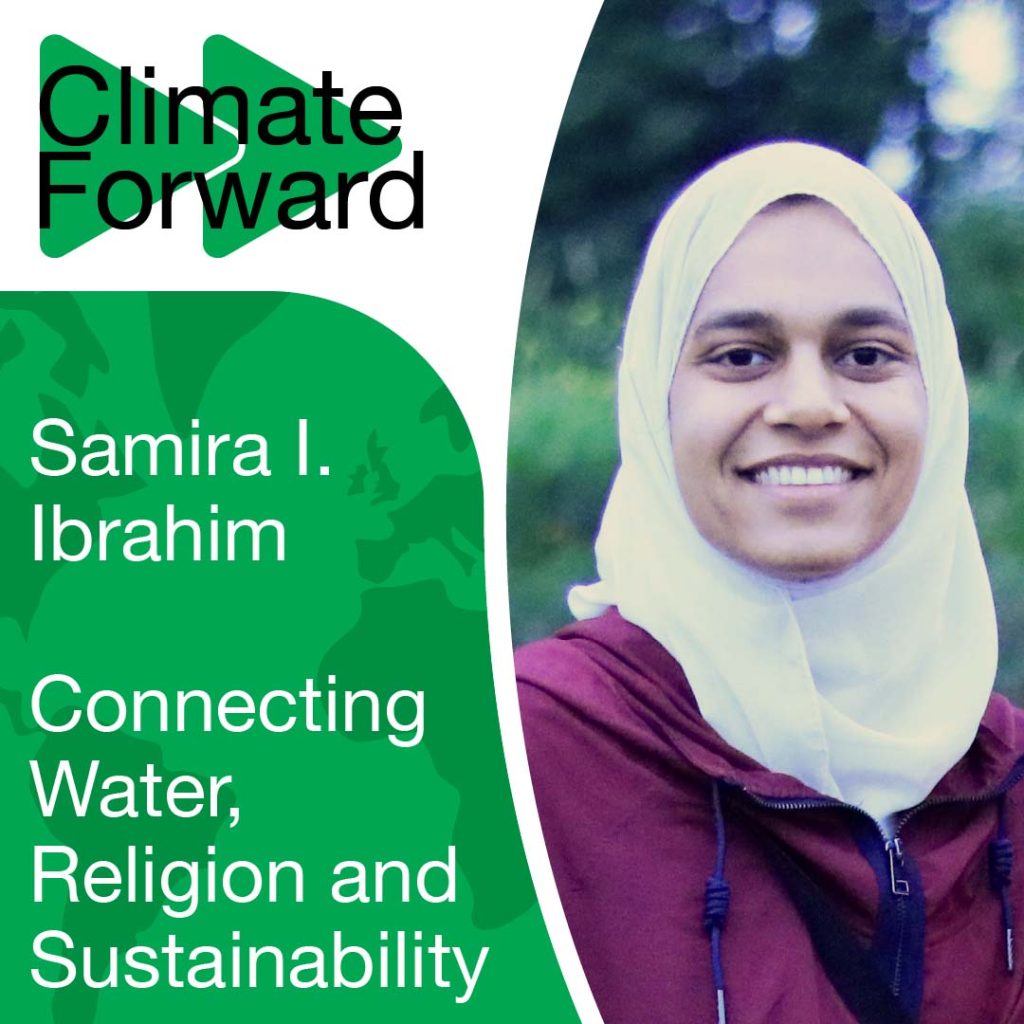
Welcome to Climate Forward, the podcast where we explore the actions and stories of the European Climate Pact ambassadors. My name is Mansur Philipp Gharabaghi, and I am your host. With Samira, we will talk about the importance of water, the connection between religion and sustainability, and the challenge of inclusivity and climate action.
Samira I. Ibrahim: 00:34
Even if you own a flowing river, you should still not waste water. At this moment, to live a sustainable life in the Netherlands, you need to have a certain financial income.
Mansur: 00:50
Samira Ibrahim, thank you very much for joining me today at the Climate Forward Podcast.
Samira I. Ibrahim: 00:56
Yeah, thank you for inviting me.
Mansur: 00:58
Samira, you have a very interesting background and a very interesting field of work, and we’re going to talk about this, and it’s very closely intertwined with your work that you want to do or that you’re doing as a European Climate Pact ambassador.
Samira I. Ibrahim: 01:13
Yes, so my name is Samira Ibrahim. I am half Dutch, half Egyptian. I was raised and born in Amsterdam, and at the age of 12, I went to live in Egypt with my parents and siblings. I stayed there for 12 years also, and I came back to the Netherlands in 2015. So that’s a bit about me personally. In terms of my educational uh developments and professionally, I started in Egypt at the University of Cairo with my bachelor in environmental and water studies, which I also finished there. And when I came back to the Netherlands in 2015, I started a master’s in water management at the technical university in Delft. And in 2018, I also did a master’s at the Fre Universiteit in Amsterdam in the field of theology and religious studies. And I studied international relations at the Klingand Institute in De Hague. And I do have a very specific reason for studying in different disciplines.
Mansur: 02:29
And I think we’ll get to that in a minute because that’s one of the sorts of linking pins between all the all the things that you’re doing. Water management. You mentioned to me that you started your studies in in Kairo and then finished them in Delft. A few episodes ago, we already had a guest that was actually working in the water field, so uh I know it is something that we need to pay a lot of attention to, and that’s really important. But you also mentioned that you studied theology and international relations. And I already know that those three things together build a net that sort of is your area of expertise. And I would very much invite you to share a bit how and why you have chosen those three fields of expertise.
Samira I. Ibrahim: 03:26
Yeah, so so let me first start with my background in uh in water engineering and water management. I was invited yesterday for a certain uh to give a certain presentation, and I mentioned exactly the same. It’s quite interesting to uh observe how uh how much water we use uh daily as human beings, but also um like I don’t know of any human being who doesn’t use water during a day, like even if I asked you the question, Did you use water today? you will definitely say yes. Either you drink water or you wake up and you wash your hands and face uh with water, you take a shower, so you are actually interacting with water the whole day. But very few people who ask themselves, where does this water come from and how did it reach me from the river to the tap I’m uh opening? And I noticed that when I was uh um growing up in Egypt, one of the main sources of life there is the Nile, the river, which is very polluted at the same time, and that was for me confusing because how can we as human beings pollute a source which is so important for uh for us? Uh and and we all know without water there is no life, like you can basically live without anything except for water. So, and then it was confusing for me also, um, the very little attention we pay to how this water is managed, organized, um but also cleaned. How does it reach us from the rain to the river to our um households? So, in Egypt, when I knew that there is a department at the University of Cairo focusing on water management and water engineering, I was very interested in joining that. And more interesting is the fact that very few people in Egypt uh focus on this kind of um knowledge. Uh, and even less people know about the existence of this kind of studies. And I came back to the Netherlands in 2015, where I also started to uh focus on water management at the Technical University of uh of Delft, and it was also a shock there to um see that some people studying at the Technical University of Delft don’t know that there is a department focused on water management and water engineering, and again it’s it’s very interesting for me because you actually can’t imagine your life without without water, and but somehow we take it for granted. However, we when for those who focus on the news and follow the news, um there are some severe um uh uh articles and and information coming from Italy, France, but also in the Netherlands that if we don’t focus uh on paying more attention to how we manage water, uh even in the Netherlands we can face uh problems with drinking water in 2030. And during my stay in Egypt, I uh as a Muslim myself, I uh was also wondering how come that a country with a majority of Muslim people, and from an Islamic perspective, water is also important because you use it for your daily prayers, but we are also taught by Islam that it’s very important to take care of water. So we have a very important saying by the Prophet Muhammad even if you own a flowing river, you should still not waste water. So we we do have a lot of inspiring um perspectives from Islam when it comes to how to interact with nature. However, I didn’t see that in practice in praktikal life in reality. And then I also decided to study more on theology and religion to understand what the reason is that we easily call ourselves uh Muslim without really practicing every detail of the religion, and of course, we are not angels, and we can’t do everything uh perfectly, but these are not unimportant stuff. How we deal with nature with water, these are not unimportant stuff. So that was one of my motivations to uh focus also on religion and theology. Uh, also, it’s a fact that worldwide 80% of the population affiliates themselves with a certain religion. Um, but we tend to forget that fact when we deal with global challenges. So when we talk about sustainability, uh international security, we usually talk about the technical stuff, the political aspects, but religion is a very powerful force, and it can be uh very constructive, but it also can be very destructive. I don’t believe that it’s smart to neglect that dimension of um when we talk about global challenges. So that was for me another motivation to include that dimension in uh yeah, in in a theme like sustainability.
Mansur: 09:24
And I already can see how the red thread then goes to Klingendal Institute for International Studies, which basically to me seems like a necessity to follow up.
Samira I. Ibrahim: 09:32
So yeah, because topics like water management, sustainability, we can’t fix it as a country independently. You need uh you need a global movement. So then um I was invited to study at the Klingedaal uh Institute and to focus on international relations.
Mansur: 09:52
A lot of very interesting topics. When we look at the water topic, I think you’re very right, we know far too little, and we don’t realize where this incredible convenience of simply turning on the tap and getting fresh water comes from and how much work goes into it. So this this is an important topic. We I think there’s no discussion about it. And there are a lot of solutions, like you said, technical ideas, you know, be more careful with water, be more aware how you use it. But you mentioned theology and religion as something that you were very interested in, and 80% you mentioned of the world population adhere or follow a religion. And I don’t know if then this is one of the big monotheistic religions or or simply that these people are spiritual in one way or the other. And I think irrespective of which religion you or spiritual movement you want to follow, many of them have built into their rules some very, very sensible thinking. That is the basis for why these things have been laid out as they are in the books that we know today. I would like to ask you to share a bit uh if you have come across these things or how you have been able to take a look at theology in connection with sustainability.
Samira I. Ibrahim: 11:22
So um two parts. So as a uh uh at one part I I really focus on uh my Islamic background and the teachings from the Islamic traditions and the Islamic community, but as a religious scholar, I also pay attention to other religions, not to teach them what their religion tells them about nature and ecology, but to make them aware, uh look at your spiritual movement or your or your religious background and the scriptures and try to get inspirations from that to um um yeah, have a better interaction with nature. Uh, and I also work on the interreligious uh part. So, uh, how can we as different religious communities come together and increase our uh impact and um work towards a sustainable movement uh together? When it’s so so when I talk uh about the content, uh it will be mainly from my Islamic background because uh I don’t see myself qualified to uh talk uh, for example, about the Jewish context or the Christian context. I know personally people who are really inspired by those traditions to do uh better for uh nature and climate. For example, in Jewish you have the concept tikkonolam to uh heal the earth. But from an Islamic perspective, as I said, um I mentioned already the saying of the Prophet Muhammad where he um inspires Muslims to be very conscious about um how you use certain uh resources, so even if you have a flowing river, don’t waste water. And this saying is for me very important because sometimes, especially now uh within uh the climate crisis, sometimes I feel that there is a tendency to say, well, let us uh take care of our um actions right now, and we need to do better because we need to save the climate, as if uh doing better is only related to the climate crisis, which uh um actually uh implicitly also says if the climate crisis is over, we can do whatever we want to do again, like we used to do. But in such sayings of the Prophet Muhammad, what I actually read also in the message is whatever your situation is, whether you have a climate crisis or not, whether you face uh problems or not, whether you are um uh facing scarcity or not, you have to be very aware of how you interact with um certain resources, and you have be uh uh you don’t uh you don’t want to waste, even if you have um not it’s like it’s not dependent on uh scarcity or having plenty uh of something. In both cases, you need to be very careful with what you use and how you use it. So that’s a very important principle uh which I take from my Islamic background and which I really try to um give a more um uh a larger place also in the awareness of Islamic communities. So, what I’m doing right now is uh also uh talking with certain mosques in the Netherlands to encourage the Imams who give the sermons on Friday to include this part in their sermons. Like um at Friday, you have hundreds of Muslims going to the mosque, uh, and most of them really pay attention to the sermon because it’s an important part of their religion. Uh, the Imam has a certain authority in his community, and so from my perspective, he also has a certain responsibility, also when it comes to these kinds of uh of topics. And what we see with certain religious communities, whether they are Muslims or Christian or Jewish, that sometimes the religious authority is way more impactful in certain communities than, for example, the government. And I do see an opportunity there for governments to work together with religious communities to cover all communities in a certain place whether they take authority from the government or their religious leaders. But um so I don’t believe that moving towards a sustainable future, including everyone, is possible without also empowering faith-based communities and strengthening the also the interfaith relations between those communities.
Mansur: 16:36
I think this specific application of trying to find ways how can we motivate people in their faith to contribute to being more sustainable is, for lack of a better word, quite inspiring. And I want to come back because the reason why we met and why you’re also sitting here with me today is because you’re a European Climate Pact ambassador. Can you tell me a little bit how you, in your work as a European Climate Pact ambassador, connect the different dots that your knowledge makes up?
Samira I. Ibrahim: 17:07
So for me, um, my ambassadorship is is really part of who I am. So the moment I start speaking about sustainability, water-related issues, or climate change, from my perspective, those are also the moments I’m acting as a climate ambassador. So um, so so for me, there is no separation between who I am, what I do, and my climate ambassadorship. Even the moments I’m reading about climate change to increase my knowledge or studying at those moment for myself, I’m also acting as a climate ambassador.
Mansur: 17:47
Um Samira, sorry if I interrupt you here. How did you find out about the climate pact? How did you come to be an ambassador?
Samira I. Ibrahim: 17:54
Yeah, so it started that uh I I was uh uh being trained as a climate ambassador at the Ministry of Economic Affairs and Climate in the Netherlands, and one of my mentors there was uh Laura de Fries, I think you know her. Yeah, and uh she at that moment she was a part of the EU uh Climate Pact Ambassador Program, and she introduced me to Fons, who is the coordinator of the program, and that way I became I became part of the pact. So it was through my network.
Mansur: 18:29
Okay, well, it shows again the power of networks, yes. Important. Um, but coming back to connecting these different dots, um, because you mentioned that right, and I want to recap very quickly. So, water studies is where your original interest in academia was, then via the Klingendaal Institute, international studies. Um, and I know that you also work at a large think tank or or or or the largest Dutch forum for sustainability. Springtide.
Samira I. Ibrahim: 18:59
Yes, yes. I am uh um very active in the academic scene. So as a researcher, but also as a teacher and lecturer. I I do a lot of research when it comes to uh so part of my research is very technical. So I do research in the water sector, which is very technical, but I also do research which uh where I where uh disciplines are overlapped. So I also write a lot on um spiritual ecology, so um studying the ecological system not only from the engineering and technical part, but also including um the religious perspectives and spiritual dimensions of uh our relation with nature. Um, and I’m also act very active when it comes to uh the social dimension. So for me, it’s very important to connect academia and uh and society and to have a social impact with my with my research. And Springtai is for me one of the places where I really feel that I can combine my different talents, uh, backgrounds and um disciplines. So uh Springtai it’s it’s as you uh introduced it, one of the uh it’s the largest Dutch forum for sustainability. And every year at the end of September we have uh a festival in uh in Terschaling. Terschaling is one of the islands uh above the Netherlands, and what we do there is that we uh invite the largest stakeholders within the sustainability field from the whole Netherlands, so those in academia, but also from the industry, from political organizations, ministry, uh all important stakeholders to come together to exchange their knowledge, to inspire each other, and hopefully to accelerate uh the movement towards a more sustainable uh uh world with a focus on the Netherlands. So that’s one of for me, SpringTe it actually uh embodies something I try to do in daily life, uh, combining um the scientific research with uh policy making, with uh NGOs and uh social impact.
Mansur: 21:32
I want to touch upon one more topic, and that is something that has to do with one of my previous guests, Willem Chodon, who talked about youth participation and he talked about the challenges of being inklusive. And you talked about going into the Muslim community into mosques to draw attention at religious service towards the topic of sustainability. Is that something where we still lack action in terms of outreach? Do we do we ignore religion as a trigger to to get change?
Samira I. Ibrahim: 22:12
Definitely. So uh and not only religion. I I when I look at the current sustainability movement, for example, in the Netherlands, I think we lack intergenerational uh interactions, we lack uh the inclusion of uh spiritual and religious um communities, we also lack the inclusion of certain social communities. So, what I refer to a lot in my presentations and talks is that honestly, at this moment to live a sustainable life in the Netherlands you need to have a certain financial income. So, as if you can only participate in moving towards a more sustainable world if you are from a certain social class. For me, that’s a very painful fact because this way you are um excluding a huge part of society who are also human beings who will also be affected with uh the uh impacts and effects of climate change, maybe even worse than those who already are financially safe, you are excluding them for working towards a better and safer and healthier environment. Uh and I I believe that’s cruel. So so um I I truly believe that um if we were really if we re if we really want to um realize a sustainable world, we can’t leave anyone behind. And I’m now actually repeating one of the slogans of the SDGs as uh as written by the United Nations because their promise was to leave no one behind. And we are now in 2023. The goal for the SDGs is until 2030. Uh, I don’t think that until now we uh are seriously working on not leaving anyone behind. So, and that’s that’s really one of my calls towards uh political institutions, ministries, and the government uh to pay more focus on how to also include all social classes when it comes to uh striving towards a more sustainable environment and um yeah to to to to empower uh also those who don’t have the financial means uh maybe to subsidize them or to make biological and um eco-friendly food more accessible.
Mansur: 25:22
Yeah, I very much agree with that, and and this is totally non-scientific and subjectiv, but depending of course which area of your city you shop in, the produce in your supermarket will vary and the amount of organic or biologically grown food will decrease or increase.
Samira I. Ibrahim: 25:43
Yeah, yeah, and also um I I do have a colleague who wrote an article on this lately, uh, that even if you look at certain cities, uh the shops where you can buy eco-friendly food, they are only in the neighborhoods where they know that people can afford them. Like even in neighborhoods where people where majority of people cannot afford them, they don’t even have the luxury to go to such places and they are not introduced to it because they usually are uh located in neighborhoods among those who can financially afford it.
Mansur: 26:22
So yeah, without going into too much detail here, uh because we did discuss this with with Willem in a previous Willem Chotonk in a previous podcast, this bias is also visible when you see at who gets active on climate action, right? The people who can become active are people who can afford to have the time to do that. If I have to work ten hours a day to put food on the table, I don’t most likely have the time at night to join the voluntary ambassador calls and the like. So I think this is something that where there’s a certain responsibility of society manifested by politicians or whatever you want, to act as a correcting factor and ensure that, like you said it before, we don’t leave anyone behind. To close off our discussion with a question about outreach and the effect of what you’re doing, I am very interested whether you see a positive response when you go into the communities and when you talk about sustainability into communities that may not expect this topic to come to them.
Samira I. Ibrahim: 27:35
To be honest, I’m very surprised by the um uh willingness of people to join certain plans and the positive responses. Uh, even in the Netherlands, we uh at this moment we have around three or four mosques really uh uh focusing also on making their buildings more sustainable, um, trying to um uh uh empower and educate themselves on how to make sustainability a part of uh also uh not only their buildings but only but also the awareness and mindset they uh spread uh uh within those uh buildings. So so I I really do see a lot of positive uh movements and actions uh happening. Um it’s not enough, definitely, but that’s not a problem uh as long as we are uh moving and going on and trying to uh take more people uh with us. Um so so yes, uh I’m hopeful myself. Uh but but I also I always say uh for me as a human being, um I’m not so much focused on the results as much as I’m focused on the process and taking responsibility. Like at the end of the day, you want to be able to look at yourself in the mirror and say, I try to do my best. Um also from an Islamic perspective, uh the results are not on are not in the hand of the human beings, like uh results they are uh in hand of God, but what human beings can do is to actually stand up and and do something. And that’s also my appeal to everyone listening, uh, to motivate yourself and stimulate yourself to reach such a point that you can tell yourself, I’m trying to do my best, whatever the outcome is, whatever the result is, whatever uh the future of our world will be, uh at least I can say that I try to do my best, that I try to empower the people around me, that I tried to uh be the best example. Example I could for others when it comes towards uh when it comes to thriving towards a more sustainable environment.
Mansur: 30:10
These are some beautiful closing words, I think. And it also shows the power of what you can do if you act, and the power of inclusion and taking people with you along the way. So thank you very much, Samira, for joining me today and for for letting us have a look into your work and what you’re doing, and also for sharing, even if only for me, maybe, some or very new perspectives and very interesting perspectives. Thanks a lot for taking the time.
Samira I. Ibrahim: 30:43
Thanks for inviting me and uh for taking the time to listen to me.
Mansur: 30:48
It was really interesting. Thank you. You just listened to Samira Ibrahim talk about the importance of water, the connection between religion and sustainability, and the challenge of inclusivity in climate action. If you want to hear more about the European Climate Pact ambassadors and their actions, subscribe to my podcast so you don’t miss out on new episodes.