Show notes
Episode summary: Flora Späth – Replacing single-use plastics in Europe’s horticulture industry
Key Topics & Guest Insights
- Flora explains the complexity of the horticulture supply chain—from growers to retailers—and how collaboration across the entire chain is essential for sustainability.
- The EuroPlant Tray initiative was born after Germany’s environmental agency challenged the industry to address the plastic waste it generates.
- The project unites growers, wholesalers, and retailers under a shared pooling system for reusable trays made of recyclable polypropylene.
- The new trays are designed for a lifespan of around 100 rotations, with nearly complete recyclability at end of life.
- By establishing one European standard, the initiative not only reduces waste but also simplifies logistics and improves cooperation within the industry.
What You Can Do After Listening
- Support or promote reuse systems over recycling—whether in horticulture, packaging, or other industries.
- Choose plant retailers that prioritize sustainable transport and packaging practices.
- Encourage local garden centers and municipalities to explore pooled or shared logistics systems to cut single-use plastics.
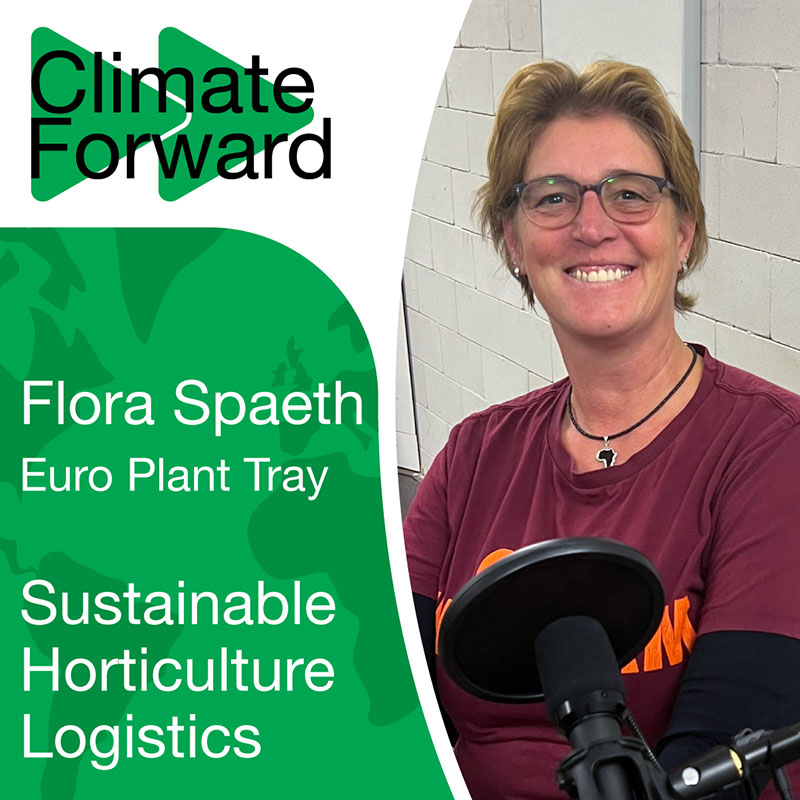
Flora Späth
Flora Späth is an experienced horticulture professional and board member of EuroPlant Tray. With over 25 years in the sector, she has worked across Europe in logistics, wholesale, and plant production. Flora now focuses on advancing sustainable solutions within the green industry, helping replace single-use plastics with collaborative, circular systems.
Links
Transcript
Mansur: 00:05
Welcome to Climate Forward, the podcast where we explore the actions and stories of the European Climate Pact ambassadors and similar thought leaders in the area of sustainability. My name is Mansur Philipp Gharabaghi, and I am your host. In this episode, I speak to Flora Späth. Flora is a board member of EuroPlant Trade and an independent consultant for the horticulture industry. In her board role at Europlant Tray, Flora is working towards replacing single-use plastic plant trays with a reusable pooling system. When the system will be introduced in 2024, it will save over 40,000 tons of plastic every year.
Flora Späth: 00:55
In Germany, about 150 million of these trays are being used every year. This is a huge, huge mountain of waste that we within the industry are producing. Our aim is to introduce the new industry standard in Europe.
Mansur: 01:11
Flora Späth, welcome to the Climate Forward Podcast. Thanks for having me. You are a board member of the Europlant Tray, and you’re a self-employed consultant in the horticulture business. Can you tell us a little bit more about this, please?
Flora Späth: 01:28
Yes, sure, I can. My name is Flora, as you just heard. I’m on the better side of 50. I’m a German living in the Netherlands already for nearly 12 years by now. I studied horticulture at some point and have now 25 years of experience in this field on different parts in the supply chain from wholesale and logistics in Italy, in the UK, in Germany, and now in the Netherlands. And recently, about a year ago, I became appointed as one of the board members of Europlantre. And I think this is where we should dive into what we are doing at Europlantray.
Mansur: 02:10
This is also what we’ll focus on today because the horticulture business or the green industry has some sustainability challenges. But before we dive into this, can you explain what is the hard horticulture business?
Flora Späth: 02:27
Well, when we talk about horticulture, we really speak about everything from plant breeding to plant growing to plant production to the wholesale, the logistics that are transporting the plant from one place to the other, ending up at the retail shops where we as consumers are buying our plants after all. So we are looking at the whole chain, um, really from the growing part to the selling part to us consumers. And these are live plants in earth, or is this also cut flowers? Uh the cut flowers are also part of horticulture. Uh, but my special field of expertise is really the live plants, the living plants, the plants that you plant in your garden, the plants that make your living room more green and more healthy for you and your kid. Uh, and uh yeah, a little bit of the fruit and veg obviously also, but that’s another uh field of expertise because fruit and veg is usually grown outside, and uh a lot of the plant protection that we are talking about is also done inside when we are talking about indoor plants, obviously.
Mansur: 03:37
Okay, so my little green cactus.
Flora Späth: 03:43
The green cactus uh will hopefully be uh transported on a Europlant ray in the future to reach from the grower to the wholesaler to the retailer where you are going in and buying the green cactus afterwards, yes.
Mansur: 03:55
So it’s a bit of a complex industry, and I would really like to understand the value chain. So it starts with a grower, I assume, and it ends up uh in my living room, most likely. But what are the steps in between?
Flora Späth: 04:09
Well, it starts with a grower. Let’s leave out the the breeding factors for now. That’s uh really a special field again. But it starts with a grower who’s propagating uh the plants, making them grow to the size that we as consumers want them. Uh, and the grower is uh either selling directly to a retailer, but we know that there are a lot of small growers, so usually we have a wholesaler in between who is collecting all the different sorts of plants, like the cactus, like the plants for the garden, like the plants, the trees for the garden. Uh, he’s combining everything, uh offering the whole assortment for indoor and outdoor plants to the retailers, and the retailers are choosing from him uh to have one contact person or a couple of contact persons for the assortment that they want to sell.
Mansur: 04:59
So I understand the value chain now. It’s quite complex, and I assume also this is happening across countries in Europe and not just within one country. Um, so the logistics must be a big challenge, right? Because you need to get plants either out of the earth or out of the place where they are grown, to the supermarket, to the consumer. Um, and I think this is where we’re sort of building the bridge to what you’re doing now, the Euro plant tray, right? I mean, can you how does it happen, right? How are plants shipped at the moment?
Flora Späth: 05:30
Well, plants are shipped on uh trolleys, and you can imagine the the or you you you know the trolleys. I’m very sure if you think back of the last time you went shopping in a DIY store, uh, especially now in spring, you see these amounts, these walls of trolleys, steel trolleys with plants in front of the uh the the retail stores. That’s also a pooling system, these these trolleys. I used to work for this company as well for more than 10 years. Um and small pots, if you would just put them on the trolleys, which are moving, their rolls, wheels under them, you could imagine, would fall off the trolley and would get damaged during the transport. So next time you’re going to garden center, have a look. The smaller pots up to 17 centimeters are standing in trays. These trays today are one-way trays. So the grower, when he receives the order from the retailer via the wholesaler, puts the plants in this tray thing, which looks a little bit like an egg box, you can compare it, but it’s made from one-way plastic. Um, he ships to the wholesaler. The wholesaler might shift the tray to another trolley to combine the orders of that particular end customer. Then the plants are going to the retailer, and this is where you are buying them. And what is happening afterwards with the tray? You are taking the pot home with you, but the tray stays behind and it’s simply waste. So we’re using this one-way packaging for the sake of two, three days of transport. But other than that, there is no value.
Mansur: 07:11
And why? So this is a single-use item. Why are they not collected back and reused?
Flora Späth: 07:17
Well, there are some things to be collected on, regrinded and reused. Um, but recycling as such is never as environmentally friendly as reuse, proper reuse is. And this is what we are going to introduce with the Europlantray.
Mansur: 07:35
So, the Europlant Trey is uh an initiative of the industry itself, uh, I understand it, or of many many players in the that are somewhat connected to the horticultural industry. And it’s trying to solve this challenge about, you know, single use plant trays. Do you have a number of what amount of plastic are we talking about here every year?
Flora Späth: 07:59
Yeah, we have a rough estimation. Maybe we need to go back a step further. It’s about two years ago that the Deutsche Umwelthilfe, the environmental uh agency of Germany, uh invited the industry, a lot of different players, about 80 players of the industry, to confront them with the fact of this single-use plastic for the trays. And the estimation at that point was that in Germany, about 150 million of these trays are being used every year. And for Europe, the estimation is something between 500 and 700 million. So you can imagine this is a huge, huge uh mountain of waste that we within the industry are producing, and that environmental agency kind of wagged their finger at us and said, Well, you’re calling yourself the green industry, but is this really green what you are doing? And that’s how it all started uh in spring 2021.
Mansur: 08:56
I mean the reaction of the industry was let’s do something about this or or or exactly.
Flora Späth: 09:01
Exactly. I mean, if if if you get confronted with facts like this, um then I think independent which industry you’re in, you can’t just say, Oh, that was a nice day and I had a free coffee and now I’m going home and I continue how I did before. Uh, this was really a wake-up call for the industry and for the players who were there. Um, and the group got together um to work on the details how we can solve that problem in the industry. And when I say we, uh it’s really the fact that there’s everybody from the supply chain involved. Um, the steps were different or multidimensional. Uh, first of all, the idea was okay, if we can’t use single plastic, what are we using instead? Uh they very quickly found that they want to go into pooling and reusing of um of the trays because, like I said before, the we in the industry also know the the trolleys. So it’s kind of a logical combination as well, apart from the environmental um advantages. Then there was a uh questionnaire sent out to 350 companies to find out well, if we want one tray, what does this tray need to do? What are the the specifics that we are expecting from a tray?
Mansur: 10:20
And when you say 350 companies, these are 350 companies along the value chain that we just explained.
Flora Späth: 10:26
So with very different interests and yeah, and even though it was initiated in Germany from the German uh environmental agency, the whole project was started on an international basis. So it was not the fact that it was only asked to German guys, but the the questionnaire was sent out internationally. Based on that one, the group got specifications at the end. I think it’s a book of, I can’t remember, roughly 100 pages or so. So it’s you think it’s just a plant trade, but it’s kind of complicated when you really get into the details. Um at the same time, there were discussions in little work groups. How are we going to do this? Our aim is to introduce the new industry standard in Europe. So there is financial things to be considered, there is sales stuff to be considered, there’s logistics to be considered. What is the right form of company to be able to do this? And who will invest in everything that needs to be done? There is the development that has been done now the last two and a half years.
Mansur: 11:27
Yeah, but who pays for all that?
Flora Späth: 11:29
We will also start production at some point of the tray, they need to be paid. Uh, and we need to consider the users who are used to pay in average 25 to 30 cents for a single-use tray. But what does it mean for the people if we suddenly ask for 10 times the amount because you’re using the tray a hundred times? Bottom line, it’s cheaper, but the initial investment is higher. So that are all things that the work group has uh looked into. Uh the group made decisions, and then last year in June, July, there was a moment reached um where due to Cartelrecht uh legislation, um we couldn’t continue anymore in a in a loose project format.
Mansur: 12:21
So antitrust legislation prevents.
Flora Späth: 12:23
Yeah, anti- antitrust law. Um obviously, you you we have big retailers um that are usually competing with each other, sitting in the project together, working on one solution. We have wholesalers that are competing with each other sitting in this project together. So all the meetings are always um under supervision of an antitrust lawyer. And we have to be very, very careful on on everything, not to share our secrets. We are having one big aim together, and that is to reduce the waste in our industry. And that’s also why the antitrust um antitrust department in Germany allowed that we are founding a company. That was all checked by the uh by the German government, um, and only with this aim that we say we are doing something on sustainability. We were allowed last year in August to to found uh the Europlant Ray Corporation.
Mansur: 13:20
Now that you have explained the challenges in setting up this organization and on the financial part, they’re all sitting in a room, but a producer probably has very different interests than a retailer. So, how does that work?
Flora Späth: 13:34
Well, like it does in every corporation, uh everybody has got one vote, and you need to have very good arguments to convince the others. Um but it’s it’s not the fact that uh just because you’re a big retailer, your vote counts more than the small grower, just to make it a little bit uh uh black and white on on that one. Uh so the money that the companies have does not represent the the voting rights, but everybody who’s sitting there has got one vote. And what I personally I’m involved in that just uh in that project since last year, August. Um I’m representing the Dutch uh Vereniging von Grotenlaren, the Dutch corporation of wholesale for the green industry. Um, and in this respect also became a board member uh of Europlant Tray. Uh, what I think is amazing every time to see that we are learning from each other. Obviously, they’re different focus points. We had a very interesting, funny discussion when we had to choose the color of the tray. That doesn’t mean anything to the to the grower or to the wholesaler, but it’s one of the most important things for the retailer because they obviously want that their shops look nice. When we discuss if the um drainage holes need to be 8 millimeter or 9 millimeter or 7 millimeter high, the retailer says, whatever, you are the specialist in growing. Whatever. So then suddenly the grower has much more impact, I wouldn’t call it, but then they are listened to more detailed simply because they are the specialist in this field. And that gives some funny situations because I mean the project as it is now is unique in Europe. That we have a whole industry working through the whole supply chain to find one solution. And we are not used to sit together and work on solutions. Uh not along the supply chain and not uh together with our competitors. Um, but only this way we can we can have a standard again. And if everybody would develop their own system and somebody is working with cardboard, and the next one with a pooling system, and the next one, I don’t know, with a wooden tray, I just uh come up with some things, that makes our supply chains very complicated again. And everything that is complicated is automatically inefficient as well. So it’s it’s it’s there’s a lot of reasons why we work together even though we are competing in in parts. But bottom line is it’s making all our lives more easy in the future and then more efficient, also.
Mansur: 16:20
Do you think from your perspective will this also be a benefit for the industry next to the sustainability benefit of introducing a reusable pooling system?
Flora Späth: 16:32
I I think it will be. Um, not only because we’re all using the same products and it makes it easier. Um but I think we also create a new awareness and level of understanding for each other. And when we understand each other along the supply chain, that automatically has got benefits on the long run because you’re you’re you’re reaching another level of discussion, uh, and you dare to also raise other subjects that might maybe also bugger you right now and which usually wouldn’t be addressed. I mean, normally the grower doesn’t speak to the retailer, there’s a wholesaler in between. Um, but automatically now we are having the direct communication and there are things just yeah, you you just get aware of things that you’ve not been thinking about before because you’ve got the direct dialogue. And I think we will have a lot of benefits also in the long run of it. And the second part is that we are working internationally. Um, when EPT was founded in 2022, we started with eight members. Today, only nine months and four days later, uh, we are 28 members. I mean, a pregnancy takes nine months, but it’s difficult to get 20 babies in one time. Uh, we managed to get that. And uh we have now um partners in Germany, in Austria, in Switzerland, in the Netherlands, in Norway. Uh we are in a lot of discussions with uh French uh different groups, uh more more companies even from Scandinavia, from retail and wholesale in the green business. And we also, on that perspective, learn from each other.
Mansur: 18:16
I would like to understand how the tray works as such. So can you explain to me how how this happens? I mean, I know you mentioned in the beginning, right, the plant gets put in something, but how would a pooling in the reuse system work?
Flora Späth: 18:30
That was a big discussion also. Um, because again, looking at the value chain, uh, it starts with the grower. The grower needs to to put the plants into the tray first, but the grower is usually not the one uh who has the money. That looks sits on the other side of the retail chain, and the retail chain demands from the grower, I want my plants in this tray. So is it really fair to put the investment on the grower side? Um as Europlantrey, we have decided that we will only rent out the trays, so they stay our assets and we stay responsible for it. Um, but if you would come and say, okay, I need 100,000 trays, then you would hire them, and they’re different models depending on what you want to spend for year hires or five years higher or long-term, really like long-term hire spreading payments, whatsoever. Uh, and then you can say, okay, I’m gonna give that to my growers myself and keep stock of the 100,000 trays to whom I gave them and when I get them back from the growers. Maybe you have a service provider who’s doing that already with other stuff in your retail department. Think about the crates where the fruit and vegetables are being transported in. Think about the displays where we which we find usually uh close to the payment points, so that we are being tempted to buy some chocolate in the last moment. Well, not we, but our kids. Um they they are standing on little blue pellets, quite often they’re blue. That is also a pooling system. So a lot of retailers have pooling service providers already connected, or a service provider who’s taking everything together, who is um sorting out the rubbish, who’s putting into recycling what can go into recycling, and returns these pooling items to the respective pooling companies which are responsible for it. So that depends very much on the particular supply chain how exactly it works, but I think I hope that you get a rough picture of how it’s working. Now, these things can break along the way, obviously. They can fall off a pallet or off one of the trolleys, and then there’s an edge where you might cut yourself, you don’t want to use it again. Um, our system um says, okay, if you have rented 100,000 trays from me and they start breaking, I mean at the beginning this will be just through normal damage, but after 15 to 20 years they start to get old and then they have just reached their lifetime, then you will bring the trays back to us. We are re-grinding them and we are making new trays out of it. And that’s the cradle to cradle uh benefits that we are having of really having a closed closed loop.
Mansur: 21:17
So there’s two things I want to ask. First, you mentioned the lifetime. This is it what 20 years? Did I hear that correctly?
Flora Späth: 21:25
It depends on how many rotations you’re you’re doing every year. You can imagine so we are saying um that they last for at least 100 rotations. If you’re rotating 10 times per year, well then you would end up with 10 years. Um we calculate roughly because that’s also very depending on the on the supply chain you’re working on, we calculate with four to seven rotations per year. But it depends on the on the product. I mean, in spring, we all buy our spring pot plants from the growers, but we only buy them for four weeks. So if I’m a grower who only has got this production and no production of autumn plants that we would then maybe put in our garden again, that grower would maybe once or twice use the tray. The thing in a pooling system is okay, I don’t use them anymore because my spring production is done and the rest of the year I’m doing holiday. Then I give them to my neighbor who has the autumn production. So I’m sharing the product as well. It’s not that we have to keep them in storage and not use them, but obviously, especially when there’s a service provider or the retailer or the wholesaler who is having year-round business, it’s very easy for them to coordinate. Okay, you get these things in spring, you get them in the summer, you get them in autumn, and you click get them for the point set years for Christmas. So that’s also efficiency within the supply chain again.
Mansur: 22:54
Yeah, I liked it a lot. So it’s actually a very, very so it’s a product with quite a long lifetime on the one hand, but on the other hand, the pooling system and this and this this you know rental or hiring system, I would assume you expect to collect about a hundred percent of any broken or or uh out-of-use uh trails back. So the recycling rate eventually of of you know the regrinding and then creating new pellets is isn’t close to a hundred percent.
Flora Späth: 23:25
It it will always be close to a hundred percent. I think we should never imagine really hundred percent, because there will be the one tray that somebody keeps in their canteen to put the coffee mugs in or serve the beer on Friday, bottle time, or something like this. Um, but yeah, in in in you can uh consider close to 100% of return.
Mansur: 23:46
And can you share which material you’re making them out?
Flora Späth: 23:49
Uh they will they will be made out of PP.
Mansur: 23:51
Okay, so polypropylene. Yeah. So it’s and it’s it’s it’s it’s a clear, how do you say that a non-blended, it’s just polypropylene, so it’s also very easy to recycle. Yeah. Okay. Wow, so I’m quite impressed. It it sounds like a huge innovation uh that that will have a dramatic impact. You mentioned several hundred of thousands of single-use trays being thrown away every year, and if if we manage to replace them with a with uh you know pooling system.
Flora Späth: 24:18
Well, our our estimation is that uh step by step we will introduce up to a hundred million trays in the pooling system. We are now working um on one size. Obviously, we have different pot sizes, so it’s not that one tray fits all because of the different pot sizes uh that need to fit. Um we are now working on the biggest group that is 10 and 11 centimeter, that’s your your normal plants that you have at home. Uh also your spring plants that you know uh in the spring season, and that’s the biggest lump and also the lump that goes uh more or less all year round. That’s the one that we decide upon in a couple of weeks’ time, actually. Um, we have tested two different trays of two different producers uh in the market, in the supply chain, and in two weeks’ time the General Assembly of the Corporation will make a decision with which uh trade to continue, and then based on that one, also start to introduce the next sizes. And over the years it’s our goal to introduce hundred million um trades.
Mansur: 25:24
And when will we see the first trays in in our markets?
Flora Späth: 25:28
In spring 2024.
Mansur: 25:30
Okay, that’s very quickly.
Flora Späth: 25:32
Uh I think uh we have to give credits to everybody who was involved until until now. It’s amazing with which speed that group has been working with all the obstacles. Uh, funnily enough, Corona helped um because suddenly everybody was aware that you can work remote and can have Teams meetings. So the the original group got together every two weeks to make the next steps, which is amazing for a project of that size. Uh, and also when I’m looking back now, what we’ve done since the official foundation and what we’ve achieved with all the colleagues and our members, uh, and the dedication of everybody to put their time in and to to sit in work groups and give the input and send the specialists of the companies to discuss details. Um, I think we all have to be very, very proud of what we have achieved uh until now. And I I really can’t wait to see the first proper trace in the shops. And I think we will have uh a little sparkling bottle popping on that day, uh, or maybe even two, uh, or maybe even 28. I guess it will be 28 members or even more at that point, who will all pop the corks on the sparkling bottle when we have the first trace really going out because we can be proud of uh what we’ve achieved together.
Mansur: 26:48
Wow, that’s a great closing word, I think. So uh I’m I’m I’m getting excited myself to see the product uh in stores. Um thank you very much, Flora, for taking the time to talk to me about this really, really interesting um topic that is maybe not so obvious to all of us, uh, but that makes a really big difference. So thanks a lot for sharing your story with me.
Flora Späth: 27:09
Thanks for asking me.
Mansur: 27:13
You just listened to Flora Späth. Flora talked about how EPT, a reusable plant tray, is revolutionizing logistics in the green industry and saving over 40,000 tons of plastic every year. If you want to hear more about the European Climate Pact ambassadors and similar thought leaders in the sustainability space, subscribe to my podcast so you don’t miss out on new episodes.