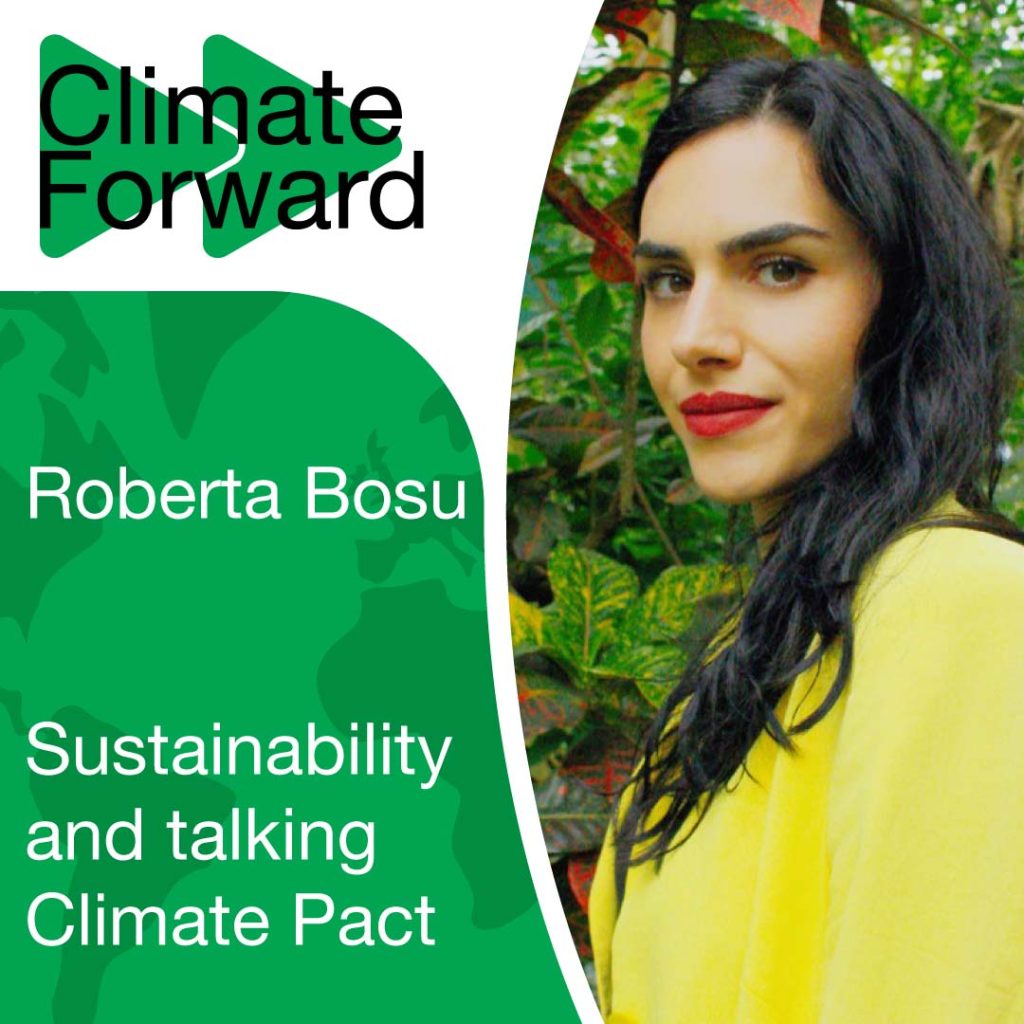
Roberta Bosu: From Instagram face challenges to worm hotels: How to make climate change communication genuinely relatable and actionable.

Roberta Bosu is a European Climate Pact Ambassador. In her role as ambassador she focuses on ways to improve communication around climate change and make it more relatable. Roberta also talks about her experience with the 30 days face challenge in Instagram, why she loves too good to go and her fascination with worm hotels in Amsterdam.
Listen to this episode on your favorite podcast app

Show notes

Episode Summary: Talking Climate Through Everyday Actions with Roberta Bosu

Key Topics & Guest Insights

  • Roberta highlights how climate communication often falls flat when it uses distant imagery and apocalyptic tone. People don’t connect with melting icebergs if they live in a small town. Instead she argues for stories rooted in everyday life, like neighbourhood composting or surplus food rescue.
  • Roberta shares tangible examples of actions: using the Too Good To Go app to avoid food waste, joining a “worm hotel” compost scheme in Amsterdam to convert scraps into fertile soil, and a 30-day Instagram “face challenge” where she simply showed what she does daily (rather than preach) so others could follow.
  • She pushes back on the “perfect activist” idea, saying that perfection becomes a barrier to participation; it’s better if many people take imperfect steps than a few attempt flawless change.
  • The power of community and relationships comes through strongly. For Roberta, shifting the narrative means engaging people where they are, inviting them into shared practices, and building a domino effect rather than issuing ultimatums.


What You Can Do After Listening

  1. Explore whether your city or neighbourhood has a community composting or “worm hotel” scheme – if not, research how you might start one and invite people you know.
  2. Download an app like Too Good To Go (or equivalent in your region) and commit to rescuing one surplus food bag this week – reflect on how this shifts both your spend and your thinking.
  3. Instead of waiting for perfect conditions, identify one everyday habit you can change this month (for example: buy unpackaged produce, take one less car trip, watch one sustainability-film instead of a sitcom) and share that change with someone else to build accountability and connection.

Roberta Bosu

Roberta Bosu is a communicator and campaigner with a background in diplomacy and sustainable development. Born in Sardinia and educated at the University of Bologna, she moved into communications to make sustainability accessible and engaging. As a European Climate Pact Ambassador and country coordinator for the Netherlands she focuses on shifting how climate stories are told — from distant crisis to relatable action. Her professional journey has spanned NGOs, the United Nations and corporate sustainability strategy, and she now uses that experience to help people and organisations tell better stories and take practical steps.

Links

Transcript

Mansur: 00:05 
Welcome to Climate Forward, the podcast where we explore the actions and stories of the European Climate Pact ambassadors. My name is Mansur Philipp Gharabaghi, and I am your host. In this episode, I speak to Roberta Bosu. Roberta is a European Climate Pact ambassador, and in her role as ambassador, she focuses on ways to improve communication around climate change. Roberta will also talk about her experience with the 30 days face challenge on Instagram, why she loves Too Good to Go, and her fascination with worm hotels in Amsterdam.
Roberta Bosu: 00:50 
Communication in general needs to be more personal, I would say, more into stories of people. So in the Netherlands they have these wonderful things that are called Wormen Hotels. So hotels for worms. When I told my mom, she was just laughing so much because she said, Oh, you wanted a dog and now your pet is a worm.

Mansur: 01:11
Roberta Bosu, welcome to the Climate Forward podcast.

Roberta Bosu: 01:15
Thank you. I’m really happy to be here. Thank you for inviting me.

Mansur: 01:19
Great for that you found the time to join me. Roberta, you are a European Climate Pact ambassador.

Roberta Bosu: 01:26
Yes, I am.

Mansur: 01:27
But you also work in communications, and uh there is a connection between those two things.

Roberta Bosu: 01:34
Oh, there is always like comme communication is uh in everything, right? So it’s that’s how I sell myself. So it’s uh there is a connection for sure.

Mansur: 01:45
So, Roberta, why don’t we start with uh introduction of yourself? Uh tell us a bit where you’re from.

Roberta Bosu: 01:53
So I’m from a beautiful island in the middle of the Mediterranean, so Sardinia. Uh I’m Italian, but I left Sardinia when I was 19. I studied, I have a background in diplomacy and international relations, and then I went to dive more into sustainable development and engagement. I fell in love with communication uh because I felt that there was a need for communicating sustainability in a better way. Uh still trying to find my way, but then uh in the last years I focused more in uh communication and engagement, especially advocacy.

Mansur: 02:25
I have to ask, diplomacy and international relations? Yes. Where did you do that?

Roberta Bosu: 02:30
Uh at the University of Bologna in Italy. So I wanted to become an ambassador when I was a kid when I was a teenager, and then more going into the NGO field. I actually worked also for an NGO and uh for one of the agencies of United Nations. Uh, and I felt that it was not really my path. Also, honestly, I didn’t want to do the exam for becoming an ambassador in Italy, it’s a mess. So I just tried to skip that part as well.

Mansur: 02:58
Um, well, you’ve become an ambassador of some sort now.

Roberta Bosu: 03:03
So my parents are happy. At least I have it, I have it in my CV, at least it’s done. Very good. I tried to try to find a different way, right? There was no example on this uh on this type of ambassadorship.

Mansur: 03:18
But uh you said you’re working in communications now.

Roberta Bosu: 03:21
Yeah.

Mansur: 03:22
Um, what do you do?

Roberta Bosu: 03:23
Uh so right now I’m actually responsible for the sustainability strategy and communication strategy of the company. So it’s um, I don’t know if I can mention the company uh for every denison. Uh it’s a corporate. Um I actually just quit my job. So it’s uh it’s also yeah, looking to um forward to finding something more into this field as well. Uh so what I do in my daily job is actually transitioning difficult uh information on sustainability, especially imagine a sustainability strategy of a corporate into something that is more digestible for different audiences as well. So uh trying to engage with uh external audiences, uh, making them understand what a big corporate does, and also what is the vision from a sustainability point of view. So, what are the goals? Uh both from a product perspective but also from an engagement, that’s also what I like more. So, how do we engage with different audiences? Uh let’s say we are part of the Ellen MacArthur Foundation or uh um yeah, big um realities in the world of sustainability. So, how do business engage with with this? It’s it’s always fascinating for me because it it makes me combine my background into the NGOs and all the social side of sustainability into more the what sometimes I defined when I was young the evil cor evil corporation or the the business word as well.

Mansur: 04:57
Don’t quote me that is maybe also a good point to ask you because before we started the recording, we talked a little bit about um what you uh what you see as the challenges for communication in in climate change or in sustainability. So in your role at uh at everyday Nison, what what are the challenges that you see towards the outside world with communicating about sustainability and climate change?

Roberta Bosu: 05:25
I think in general, also it’s uh it’s always trying to find your tone of voice from uh from a business perspective for sure, but also as an individual, I would say, also as an ambassador. Uh it was also I think for all of us, and sorry for including all of you uh folks and ambassadors, it’s always trying to find okay, I have so many things to do and uh to know sorry, to to communicate uh that I don’t know where to start. What is my tone of voice as well? And then you also need to understand who is outside and how is perceiving the message as well. So the communication right now around climate change is a lot of about oh my god, we are dying. So it’s doomism. It’s uh yeah, we need to reach this goal and uh we need to do this, and the time is ticking, and uh, yeah, the time is flying. That’s that’s all about emergency. And a lot of people really, yeah, you know, the um grieving phases, right? When when someone is dying or is just dead, or you’re losing a partner even when you are just breakup. The first thing that you do is denial. This is the first phase, or you just kind of keep it defensive because you are, yeah, it’s um if you think about it, you’re questioning the lifestyle of other people, right? You’re questioning their values, you’re questioning their maybe political um beliefs. So for me, what is what is challenging is also be on point, I would say as well. Like, what do you want to communicate? How do you communicate that? There are a lot of information out there, especially right now with social media, that you need to be straight to the point. What do you want to do? Well, communicate to whom, and how do you get the right information to the right people?

Mansur: 07:19
So when I listen to you a little bit, it sounds to me like you know, the analogy of the boy who cried fire, or is it the boy who cried wolf?

Roberta Bosu: 07:27
Oh, yeah, yeah. We also have it in Italian as well, the story.

Mansur: 07:31
It sounds a little bit like this uh that there’s there’s so much uh you know the crisis is now, and I so I don’t want to diminish this. I I I am firmly convinced that we are it’s not five to twelve, it’s one to twelve, and there is a absolute dramatic crisis that we’re facing. But maybe this has been repeated over and over that people are becoming a little bit numb.

Roberta Bosu: 07:55
Yeah, I think it’s also uh yeah, don’t get me wrong. I I’m totally with you. I mean, we are uh we have this role also to spread the voice because the we are we are I also have echo anxiety to be honest as well. I it’s but at the same time, if you think about also all the information that we had for the about the war in Ukraine, all the things that happened in Iran, like the attention span of people is also just really you cannot keep the uh constant anxiety about things for a long term as well. So if you just look at the um at the newspapers right now, all it’s about emergencies, all the images that we have out there are also far away sometimes from the things that we have right now. Um we were discussing before about the images of polar beers or uh like these uh aerial pictures of power plants. I imagine my parents in the center of Sardinia, yeah, honestly, they really care about climate and environment in general, but polar beers is not something that they see every day. So, how they can relate to those kinds of information. So you get people more into the like, okay, yeah, we are really sorry about them in the Arctic or uh the North and South Pole, but how is this relatable to our life in the center of Sardinia or even our life in Amsterdam? So you really need to uh like communication in general needs to be more personal, I would say, also more into stories of people because that’s we are human beings, so that’s how we connect. We connect through relationships, not through um yeah, stories and doomies more uh apocalyptic uh news.

Mansur: 09:43
I think actually that’s a really good bridge to what your focus as a climate pact ambassador is. Because and that’s just to mention we’ve now I’ve had the privilege of talking to several people who were in a way saying similar things that as you are saying, yeah, we’re not reaching everyone with what we’re saying. Um maybe we’re even just talking to like-minded people that influences a little bit how we see the world. Um as an ambassador, I know that your focus is communication and engagement. How do you implement the things that you see also in your corporate job, but also in your personal life, in your work as an ambassador?

Roberta Bosu: 10:31
Yeah, it’s I would say it’s our challenge as well, definitely. Like the how, because we know what is happening, we know uh who to target as well. The challenge for us is how. So, what I thought, because I I I realized okay, for me, as a communicator, as a um creative as well, what is my power? I’m a people person, I can talk for hours. Uh, but also I can uh I can bring people with me. So I’m able to uh how can I leverage this ability also outside? So at first I also said I was just starting writing things like I like to write, then of course I was just starting with LinkedIn, but then as you said, what I found is that the audience is only like-minded people, so I was kind of clapping uh by myself myself, or like people were just like, oh yeah, we agree, but then we I was not really making any impact or just not really engaging someone that is external to this, right? So I thought, okay, let’s get out of my comfort zone. What can I do? Um then I started a very stupid thing, actually. Uh a friend of mine started this challenge on Instagram. Uh, it’s the 30-day uh 30 days uh face challenge, it’s called. So you just need to put your face on the stories for 30 days and talk. And then at first, I have to say it. Um, so I really felt like, okay, I can do it. I really hate to see my face on on the screen, uh, but I can do it. My first days were so boring because I was just sitting, I wanted to be really okay, I know what I’m talking about, you know? And then I was sitting, I I wanted to say something that it was like uh that it could engage people, that it was informative, engaging. I mean, it’s it’s quite ambitious, right? So you I was just sitting, those stories were so long and boring that even my partner just said, okay, Roberta, maybe let’s improve this. So I just said, okay, you know what? I would be myself. I would just share what I do every day, right? So that I can also be, yeah, I always claim that uh communication needs to be relatable, that it needs to be personal, and that I’m doing even myself, I’m doing something that it’s boring and not engaging everyone, and maybe sharing just some data from some report. So, okay, I would just talk about what I do, and then that’s what I did. So uh, for example, I maybe um you know, and also the people that are listening know Too Good2go, the app. So I’m a very big fan of food in general, and if I can save the planet uh or uh save food waste at the same time, uh that’s great for me. So I just started to do this in my neighborhood. Uh I started collecting some food uh through Too Good2go, and it’s nice because I’m saving money. I mean, I don’t know if you saw the prices of food lately, so that’s already a thing.

Mansur: 13:40
I’m very much aware of that.

Roberta Bosu: 13:42
Exactly. Um I’m saving money. It gives me also more creativity because I don’t know what I will get as well. So I just uh like I have a bunch of food, and then every night I’m just like, okay, what can I do with this? So it’s kind of a nice challenge as well. And then honestly, I also can’t sorry Roberta.

Mansur: 14:01
Can you maybe quickly explain what to good to go is? Because I’m not sure if all the listeners are aware of that.

Roberta Bosu: 14:06
For sure. So to good to go is um an application that connects people and businesses, basically. So you have a list of restaurants, you have a list of uh supermarkets, uh yeah, mainly mainly those uh actors right now. So you can select the location and also the distance. So let’s say that you wanna just have uh shops and restaurants that are one kilometer from you or 500 meters because you’re lazy. Uh, then you have all the lists, you can even select the diet. For example, I put the vegan and vegetarian. So if you don’t want to have meat or something, you can also have that option, that it’s great. And then you just go, um, the package is a surprise, so you don’t know what you will get. Uh, but then you know the cost, uh, and also like the um uh the time that you need to go and pick it up. So usually I go to these small markets. I live in Amsterdam in a nice area where there are also small shops that sell uh vegetables and fruits. So they always have these uh huge, honestly, huge bags of fruits and vegetables, and then you go at a certain uh time. So let’s say it’s usually after um after work, so it’s also a perfect time. And then I go there and I connect it with them. So one of them, uh, for example, is Ali. We are friends right now, even though he calls me Rossanna instead of Roberta. But yeah, it is what it is. I accepted that. I’m Rossana for him. And uh so I go there and honestly, now that we are friends, he even gives me more food. I feel like when I’m home in Sardinia, that my dad wants to give me food when uh to put on the suitcase uh for when I go to the net back to the Netherlands. It’s the same. Like Halia is just like, oh, do you like this avocado? Oh, do you like this? And then I come back home with a bag full of uh of food. And it’s for me, it was yeah, also from a personal perspective, it’s really nice because I’m saving money. I have wonderful and fresh food, actually. So I’m also saving food, and at the same time, I have a connection with someone in my neighborhood that doesn’t know my name properly, but at least he can recognize it’s me. So it’s uh yeah, that’s uh that’s too good to go. Coming back to the story. Um, so I started sharing this actually. I literally shared this story and then of me going by bike and the huge bag because I also showed the video with all the food that I got uh in my stories. And then some people, I mean, I don’t have a huge reach uh on Instagram, but I mean who cares? I just want to make a change in my own circle as well. So some of my colleagues um that are not into sustainability, so not really my target, usual target audience on LinkedIn, they just said, Oh, but this is actually cool because I don’t like to cook, so I can actually even get pre-prepared meals from a restaurant or a bar. And then they started using that. So for me, I was just like, Oh, I’m really happy. This made uh this really made my day. So yeah, I started seeing those things also from um sharing even um more actionable steps. So to good to go was one of the first, so was related to food because I’m a foodie, but there are also other other simple things. Like I shared uh another uh um tip and application that is called uh waterbeer. So waterbeer is a network, I call it the sustainability netflix, actually. Uh Netflix for sustainability in proper English. Um, so I also shared that. Uh so Waterbeer in Waterbeer in this network, you can find a lot of um uh movies, uh, you can find a lot of uh documentaries, and it’s all about sustainability 360. So if you’re interested in food or apparel or whatever I would say, uh is there. So it was nice because I also shared that tip, and then a lot of people said, Oh, okay, actually, I can instead of just spending my day bind watching something on Netflix, I can actually watch this that is actually a uh platform for free. So you can also inform yourself, and uh yeah, yeah, that’s uh that that was was also like a nice um engagement that I had because people were starting writing to me and they also wrote to me, Oh, can you give me some tips, some documentaries or movies that you saw that uh can be a nice uh can give me a nice overview on a topic.

Mansur: 18:43
And you also included this in your Instagram challenge that you give to yourself?

Roberta Bosu: 18:48
I also included that. So I try to to be less boring, so less like a lecture. And uh we were also discussing um before uh Mansour on the fact that you don’t need to shame and blame in um in communicating with sustainability. So what I tried is just like I kind of shift uh shifted uh the gear, so I thought, okay, instead of just thinking about the others, I will think about myself. So that’s what I do. Those are the tips and the things that I do daily. Do you want to come along with me? That was my approach. So I kind of went out of my comfort zone and I said, this is what I do, and look, it’s also easy. You can make friends, uh, you can have a nice uh evening as well at home. Anyway, you are watching Netflix light. It’s something that is more relatable. Netflix or Prime Video, whatever. We are not uh Netflix is not paying us, so let’s give uh opportunity to other ones as well. Um, so I thought that’s something that everyone is doing eating, right? So too good to go. Uh watching movies, too good to go. Uh well, sorry, water beer. Um, then also some some relatable things like okay, I go uh I go by bike. I mean, in the Netherlands is easier than uh than in other places, but maybe also the choices that you can have uh for moving or uh for doing something that people don’t even know. Like, for example, one of the initiatives that I started was composting in my neighborhood. Uh so in the Netherlands they have these um wonderful things, I don’t know actually in The Hague, in Amsterdam for sure, that are called wormen hotels. So hotels for worms. That when I told my mom, she was just laughing so much because she said, Oh, you wanted a dog and now your pet is a worm. I said, Yeah, mom, that’s uh life of millennials in uh apartments in uh in Amsterdam. So, what we actually did, so I got interested from that because I saw this um Wormen Hotel in Amsterdam, and it has a shape of a pyramid. Like the new ones, no, but the old ones, yes. So honestly, when I saw it the first time that I was walking by the neighborhood, I was just like, what is this? Is that a temple? So yeah, imagine how how smart I was that uh that evening. Then I just stopped by and um and then it was a description, it was a warm hotel. So I got I got interested, and then I looked into the website and then I saw that it’s a community project. So it’s uh my neighborhood and also in different neighborhoods in Amsterdam, they do the composting together. What is composting? Just um 101. It’s basically uh we collect all the food uh waste, so all the scraps actually of food when you are cooking, instead of just going to the landfill, so directly to the garbage and then chow chow, or it gets burned, or landfill that it’s even worse because it produces uh it produces methan. Uh then it we compose that. So we actually give in we are giving food to the worms again as a pet. So you bring the food to the worms, the worms are really happy, and then they digest, they start eating this food and they digest it, and like we every one of us studied probably in primary school, that they produce the hummus, you know, this is something that is very fertile. And it’s funny because yeah, it’s literally it takes me um three minutes walking from my house to the warm hotel. So it’s also a nice exercise for me to get out of the house because I work remotely. And then uh every now and then, so when it’s when it’s full, this warm hotel is full, then we have this harvest day, and it’s lovely because I got to meet a lot of people in my neighborhood. Uh, I got also very nice soil for my plants. That’s great if you have a garden or if you are a plant-obsessed like me. And we had a wonderful day that day because it was we had food, we uh we just connected with the community and we did something good for the planet. So for me, also in those 30 days, what I try to show is that sustainability is not uh something that is painful. It doesn’t need to be something that is more expensive, it takes you more time, uh, or you’re just uh kind of um I don’t know, um going out of your of what is your life, like changing your lifestyle that much. It can be something that is nice, you’re connecting with more people, you are connecting more with yourself, and you’re doing also something more for the planet.

Mansur: 23:36
I think that’s very much what a lot of ambassadors think their work should be about. Yeah. It’s about you know bringing this complex message that is uh thoroughly understood by a few that have a very specific idea of how to implement it. It’s bringing this message to a lot of people and helping a lot of people maybe change a little bit, and there will have a big impact. Um and I had to think of of Alex uh of Alexander Frech, uh I spoke to him about the value of water and he said, Look, we can do so many things better without giving up the level of comfort and luxury that we have, yeah, uh but still safe. So yeah, I I’m I really like that because this is for me this is the embodiment of this of how we can trigger change.

Roberta Bosu: 24:29
Yeah, and I think also people think that us uh as activists are actually the heroes of climate, you know, that we are just uh hundred percent perfect, you know, that is just uh we are all vegan, uh we don’t buy anything, we don’t fly, we don’t do like it’s the the heroes of perfection. And yeah, I would say perfection sometimes is also the enemy of action, right? That is just that we are not like this. We also I also take some flights, uh I I also need to buy some things. Sometimes I also I’m also a victim of marketing. I just see one nice thing in a shop and I have to think about it because the first impulse is just like, I really would like to have that jacket. You know, that I’m also a human being. We are not heroes that we are just wearing a green hat and uh just say, oh, let’s not eat beef. Like we also have our challenges, and that’s also what I wanted to show to show also during this stupid challenge as well, that we are we are in we are not perfect. And what I think is also that we need more imperfection in sustainability. Like if the majority of us is not perfectly sustainable, it’s always better than having 10 people that are perfectly sustainable. And yeah, as you said, that’s also what what we try to do as an ambassador, right? We try to show the personal stories where people can really relate and just say, oh, okay, it’s easy. I have a warm hotel next to my house. I can also do that. I can also bike to good to go, and maybe Ali will know my name better than Roberta’s name. Or I can also go to the market, you know. Sometimes instead of just going to, I will not mention the name of supermarkets, but some supermarkets in the Netherlands are really full of plastics, right? So the things are all wrapped, even bananas. I’m I have no idea why they’ve wrapped bananas, but yeah. And then I studied this thing with my friends and said, okay, we’re meeting up for a coffee anyway. So let’s do this. We go to a market on a Saturday morning, we work together, we get a coffee, and then we actually buy fruits and vegetables from the market. So it’s quality time together, but we are also doing something that is good for the planet. So sometimes I also think, yeah, trying to share these actionable, uh sustainable steps, uh not from an influencer point of view, you know, those uh 10 things that you can do to be more sustainable. The green uh green warriors. Uh oh, I re I read an article about echo warriors, and uh yeah, I was my my partner always makes fun of me saying, Oh, you’re an echo warrior. So I think instead of just uh we need to change the communication also on this, right? You don’t need to be an echo warrior or the I don’t know, Xena, the warrior princess of the of the green uh and sustainability. But you can do something that is more, right? Compost, you have uh worm as a pet, uh you go to with too good to go, you go with your friends, and maybe you go just for a walk instead of just uh taking the car. Um yeah, so that’s what I try to do. At least people uh had to to hear my stories for 30 days. So right now I try to not be as active as I was in that month.

Mansur: 27:55
But I hope you still post, and uh I think that that lovely brings us full circle to to where we started, to communications and and what you do and what you want to do. And and I think it’s a your story is really inspiring. I think it it shows that small steps can have a big impact if a lot of people do them.

Roberta Bosu: 28:13
Yeah, and I also think uh what what I want to stress uh to highlight more than to stress the fact um what I want to highlight is that we are not alone, like no one of us is alone, and we cannot solve, as I said before, there are no climate heroes, right? So we cannot solve this challenge alone. But we if we create the the communities, I really believe in the power of relationships, and that’s how communication should transition more into the stories because that’s how we build relationships, and then that’s how people will not feel overwhelmed by this challenge because they already know, like, okay, there is Roberta that is doing this, let’s do this with Roberta. Like, let’s go to the market with Roberta, and then Mansoor will follow, and then a friend of a friend. I I I really believe in the domino effect for sustainability. That’s uh that’s yeah, I think I’m a believer.

Mansur: 29:12
Well, those are good closing words. So it’s a slogan. You can see that I work in communication, right? It’s actually quite good. So um, yeah, I’ve thank you very much, Roberto, for taking the time to talk to me. This um time flew by after the same. It’s really interesting to hear what you do.

Roberta Bosu: 29:30
That’s true.

Mansur: 29:31
Thanks a lot.

Roberta Bosu: 29:32
Thanks a lot, Mansur. Um, yeah, it was lovely. It was my first podcast, so I’m I’m really happy that I spent the time with you, and uh, thanks a lot for giving me the opportunity.

Mansur: 29:43
Thanks. You just listened to Roberta Bosu talking about the challenges of communicating around climate change in a relatable way, her love of too good to go, and the fascinating story of worm hotels in Amsterdam. Them. If you want to hear more about the European Climate Pact ambassadors and thought leaders on sustainability, subscribe to my podcast so you don’t miss out on new episodes.

More episodes